
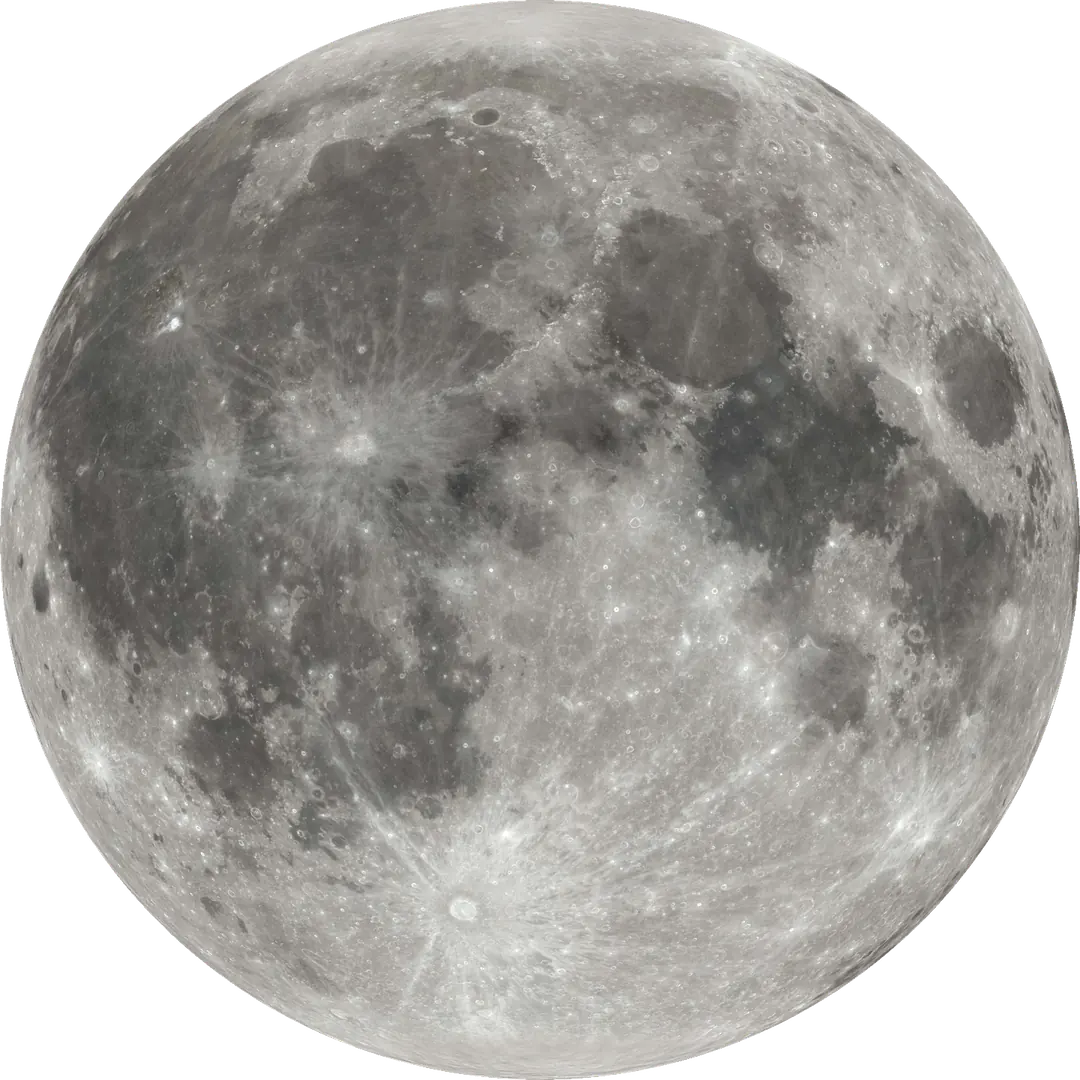
A full moon is the instant when the Moon stands directly opposite the Sun, 180° away in ecliptic longitude, so the whole side facing Earth is lit. Full moons return every 29.53 days on average, 12 or 13 times a year. Around each one, the Moon looks full for about three nights.
What is a full moon?
A full moon is a single moment: the instant when the Moon’s ecliptic longitude is exactly 180° from the Sun’s. At that moment 99.8–100% of the Moon’s Earth-facing disc is lit. The figure is rarely a perfect 100% because the Moon’s orbit is tilted 5.14° to Earth’s orbit. The Moon therefore usually passes a little above or below the exact line from the Sun through Earth.
The Moon looks full for much longer than that instant. Its lit fraction stays above 99% for about 43 hours on average and above 97% for about three days. To the eye, the Moon looks full on the night before, the night of and the night after the full moon.
The full moon is the fifth of the eight phases of the moon. It follows the waxing gibbous phase, when the lit part grows each night, and leads into the waning gibbous phase, when the lit part shrinks. The opposite phase, the new moon, comes about 15 days before and after each full moon, and its own page counts down to the next new moon.
This site calls a calendar day a full moon day when the full moon instant falls inside that day. The live tool above calls the Moon full when the current time is within 12 hours of the instant.
- Average time between full moons
- 29.53 days
- Full moons per year
- 12 or 13
- Lit at the full moon instant
- 99.8–100%
- Time above 99% lit
- about 43 hours
- Brightness
- magnitude −12.7
How can you tell if it is a full moon tonight?
It is a full moon night when the Moon rises in the east around sunset, looks completely round, stays up all night and sets in the west around sunrise. This timing follows from the geometry. The Moon is opposite the Sun, so it climbs above the eastern horizon as the Sun sinks in the west and reaches its highest point around midnight.
Moonrise comes about 50 minutes later each day on average, so the Moon’s position at sunset tells you how close the full moon is:
- The Moon is just rising in the east at sunset. It is full, or within about a day of full.
- The Moon is already high in the eastern sky at sunset. It is a waxing gibbous, and the full moon is still at least a day or two away.
- The Moon rises an hour or more after dark. It is a waning gibbous, and the full moon has passed.
The season changes how high the full moon climbs. A winter full moon rides high across the sky, and a summer full moon stays low. The full moon sits opposite the Sun, so it follows roughly the path the Sun takes six months later. For the rise time and direction where you live, see the moon tonight.
When are the next 12 full moons?
The next 12 full moons are listed below with their exact time in UTC, their traditional name, and flags for supermoons, Blue Moons and lunar eclipses.
| Date & time (UTC) | Name | Distance | Notes |
|---|---|---|---|
| , 14:54 | Beaver Moon | 360,754 km | Supermoon |
| , 01:28 | Cold Moon | 356,729 km | Closest supermoon of the year |
| , 12:17 | Wolf Moon | 357,635 km | Closest supermoon of the year |
| , 23:24 | Snow Moon | 363,296 km | SupermoonPenumbral lunar eclipse |
| , 10:44 | Worm Moon | 372,518 km | |
| , 22:27 | Pink Moon | 383,421 km | |
| , 10:59 | Flower Moon | 393,893 km | Blue Moon (seasonal) |
| , 00:45 | Strawberry Moon | 401,943 km | Micromoon |
| , 15:45 | Buck Moon | 405,968 km | MicromoonPenumbral lunar eclipse |
| , 07:29 | Sturgeon Moon | 405,069 km | MicromoonPenumbral lunar eclipse |
| , 23:04 | Harvest Moon (also Corn Moon) | 399,341 km | |
| , 13:47 | Hunter's Moon | 389,926 km |
All times are in Coordinated Universal Time (UTC). To convert, add your time zone’s offset. New York is UTC−5 (UTC−4 in summer), London is UTC+0 (UTC+1 in summer), and Sydney is UTC+10 (UTC+11 in summer).
The moon phase calendar shows every phase day by day, including the quarter moons between these dates. To get each full moon as an event on your phone or computer, you can add moon phases to your calendar with the free iCal feed.
Why is the full moon time the same worldwide but the date different?
The full moon happens at one instant for the whole planet, so every place shares the same moment but reads a different clock time, and sometimes a different date. The full moon of April 2, 2026, for example, came at 02:12 UTC. In New York that was 10:12 p.m. on April 1, in Los Angeles 7:12 p.m. on April 1, and in Sydney 1:12 p.m. on April 2.
The Moon looked equally full from all three cities. Within 12 hours of the instant, the lit fraction changes by less than 1%. The local date matters for calendars, not for the view.
This site assigns traditional names and monthly Blue Moon flags by the UTC date. A full moon close to midnight UTC at the end of a month can fall in the next month in Asia and Australia. A full moon just after midnight UTC on the 1st can fall in the previous month in the Americas. Either shift can change a local calendar’s name for that full moon or move a Blue Moon.
What are the full moons called?
Each month’s full moon has a traditional name, from the Wolf Moon in January to the Cold Moon in December. The Farmers’ Almanac and the Old Farmer’s Almanac popularized these names in the 20th century. They draw on Native American, Colonial American and European traditions, and the guide to full moon names gives the meaning and alternative names for all 12.
One name moves. The Harvest Moon is the full moon nearest the September equinox, so it falls in October about one year in five. In those years the September full moon is called the Corn Moon. The following full moon, usually in November, keeps the name Beaver Moon, with Hunter’s Moon as an alternative.
What are supermoons and micromoons?
A supermoon is a full moon that occurs within 90% of perigee, the closest point of that orbit, and a micromoon is a full moon near apogee, the farthest point. The Moon’s distance at full moon ranges from about 356,400 km (221,457 mi) to about 406,500 km (252,587 mi).
At the extremes, a supermoon looks up to about 14% larger and about 30% brighter than a micromoon. NASA notes that the difference can be hard to see by eye on a single night. Side-by-side photos taken with the same lens show it clearly.
What is a Blue Moon?
A Blue Moon is an extra full moon: the second full moon in one calendar month, or the third of four full moons in one astronomical season. Neither kind looks blue.
A Blue Moon arrives about once every 2.4 to 2.7 years on average, depending on the definition. It exists because the full moons drift about 11 days earlier each year. After two or three years, that drift squeezes a 13th full moon into the calendar year or a fourth full moon into one season.
When is a full moon also a lunar eclipse?
A lunar eclipse happens only at full moon, when the Moon passes through Earth’s shadow. Most full moons miss the shadow because the Moon’s orbit is tilted 5.14°, so the Moon usually passes just above or below it. Eclipses are possible only during eclipse seasons, which recur about every 173 days.
The table above flags every full moon that brings a lunar eclipse. During a total eclipse the Moon often turns a coppery red, the effect known as a blood moon.
When is the best time to see and photograph the full moon?
The best time to see the full moon is at moonrise, around sunset, when it sits low in the east against a twilight sky. Local moonrise and moonset times give the exact minute for your city.
A rising full moon often looks huge. This is the moon illusion, a trick of perception rather than optics. Next to trees and buildings, the brain judges the low Moon as larger, although the Moon is no bigger in the sky than when it is high. Low in the sky the Moon also looks yellow or orange, because its light crosses more air.
For photos, a few habits make the biggest difference:
- Shoot on the evening before the full moon. The Moon then rises shortly before sunset, so the sky and the landscape are similarly bright.
- Use a tripod and the longest lens or zoom you have. The Moon spans only about 0.5° of sky, so a wide-angle shot turns it into a small dot.
- Expose for the Moon, not the sky. On a phone, tap the Moon and lower the brightness until surface detail appears.
- Include a foreground. A skyline, a hill or a tree gives the Moon a sense of scale.
Does the full moon affect sleep or behavior?
The evidence that the full moon changes how people sleep or behave is limited. A 2013 laboratory study in Current Biology, led by Christian Cajochen, found shorter and lighter sleep around full moon. Volunteers slept about 20 minutes less, took about 5 minutes longer to fall asleep and showed 30% less EEG delta activity, a marker of deep sleep. One laboratory study cannot show that the Moon changes sleep for everyone, and the popular idea that full moons cause unusual behavior remains a belief rather than an established finding.