
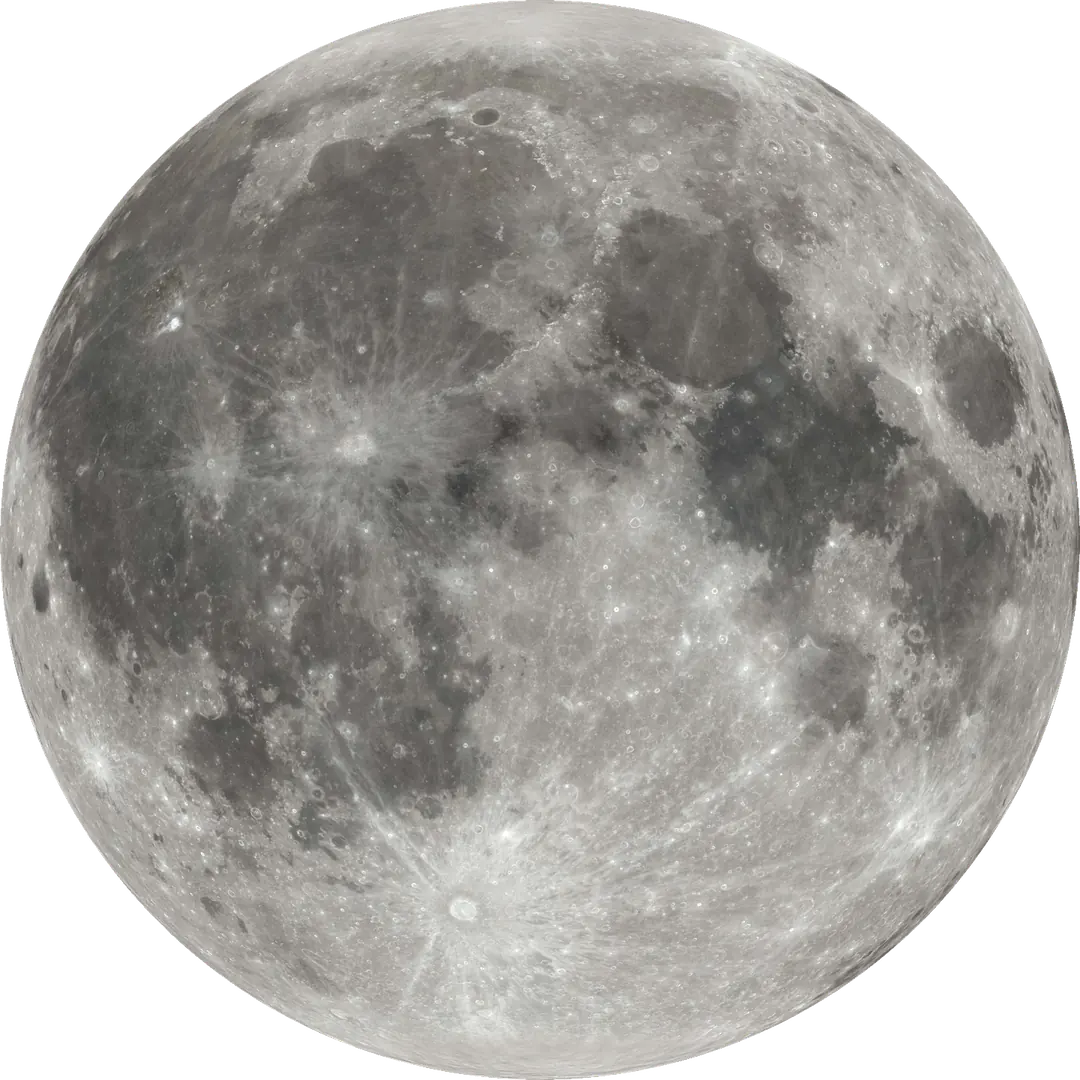
The next Wolf Moon is full on . The Wolf Moon is the full moon of January in the traditional North American almanac naming, and the first named full moon of the calendar year.
When is the Wolf Moon?
The Wolf Moon is the full moon that falls in January by Coordinated Universal Time (UTC), and the table below lists the upcoming dates with local times.
A full moon is a single instant, so its calendar date depends on the time zone. A Wolf Moon early on January 1 in UTC still falls on December 31 in New York, while a late-January full moon can land on February 1 in Sydney. This site assigns the name by the UTC month and prints all four clocks side by side. For the very next full moon of any month, named or not, see the next full moon.
When January holds two full moons, both appear in the table, and the second is also a Blue Moon. The next named full moon, February’s Snow Moon, follows about 29.5 days after the Wolf Moon. A day-by-day view of the phases around one Wolf Moon is in the moon phases in January 2027.
The Wolf Moon opens the yearly cycle of full moon names popularized in the 20th century by the Farmers’ Almanac and the Old Farmer’s Almanac.
Key facts
- The Wolf Moon is the full moon of January; this site assigns the name by the UTC date.
- The name refers to wolves heard howling in midwinter, not to wolves howling at the Moon.
- At New York's latitude the Wolf Moon climbs about 63–77° high and stays up for 14–16 hours.
- Every January has at least one full moon, and occasionally two.
Full moon time around the world
The Wolf Moon is full at the same instant everywhere, 12:17 UTC on Friday, January 22, 2027, which is 7:17 AM on January 22 in New York and 11:17 PM on January 22 in Sydney.
Los Angeles
04:17
Fri 22 Jan · PST
New York
07:17
Fri 22 Jan · EST
London
12:17
Fri 22 Jan · GMT+0
Your time
12:17
Fri 22 Jan · UTC
Delhi
17:47
Fri 22 Jan · GMT+5:30
Sydney
23:17
Fri 22 Jan · GMT+11
Why is it called the Wolf Moon?
The Wolf Moon is named for wolves, which were often heard howling in the depths of winter.
Sources disagree on where the name began. The Old Farmer’s Almanac says the Wolf Moon is not a traditional Native American name and is thought to have English origins, brought to North America by European settlers. The Farmers’ Almanac instead credits several Algonquian-speaking peoples of the northern woodlands, with early settlers adopting the name afterward. Both accounts tie the name to the same winter sound.
Wolves do not howl at the Moon. According to the Old Farmer’s Almanac, wolves howl to locate pack members, reinforce social bonds, define territory and coordinate hunting. The Farmers’ Almanac adds that wolves are most vocal in the late-night hours, when a full moon happens to be high and bright.
Other names for the January full moon
Other names for the January full moon include the Old Moon, Moon After Yule, Hard Moon and Spirit Moon, and most of them describe deep cold or the middle of winter.
The Old Farmer’s Almanac lists these January names with the peoples it credits:
- Center Moon (Assiniboine), marking roughly the middle of the cold season
- Cold Moon, Frost Exploding Moon and Great Moon (Cree)
- Freeze Up Moon (Algonquin)
- Hard Moon and Severe Moon (Dakota)
- Canada Goose Moon (Tlingit)
- Greetings Moon (Western Abenaki)
- Spirit Moon (Ojibwe)
European and colonial names include Old Moon and Moon After Yule, both listed by the Farmers’ Almanac and timeanddate. Moon After Yule places the full moon after the midwinter festival season. December’s full moon, the Cold Moon, carries the matching name Moon Before Yule.
Where is the Wolf Moon in the sky?
The next Wolf Moon, on , is in the constellation Cancer. The Wolf Moon rides high in the Northern Hemisphere winter sky, because a full moon sits opposite the Sun and the January Sun stays low.
At the latitude of New York, the January full moon climbs about 63–77° above the southern horizon at its highest point. A June full moon at the same place reaches only about 20–32°. At London’s latitude the Wolf Moon peaks at about 52–66°. It also stays up for a long time: about 14–16 hours from moonrise to moonset in New York.
The Wolf Moon usually sits among the stars of Gemini or Cancer. In about one year in three it passes within 10° of Castor and Pollux, the bright twin stars of Gemini. Orion, Taurus and the Pleiades shine to the west of the Moon in the evening sky.
Is the Wolf Moon a supermoon?
Yes. The next Wolf Moon, on , is a supermoon, 357,635 km (222,224 mi) from Earth. The Wolf Moon is a supermoon in some years and not in others, and the table above flags the years when it qualifies.
A supermoon is a full moon within 90% of perigee, the point of the Moon’s orbit closest to Earth. Supermoons arrive in runs of three or four consecutive full moons, and that run drifts later in the calendar from one year to the next. The Wolf Moon therefore qualifies in clusters of consecutive years, separated by gaps of several years. A supermoon looks up to about 14% larger and 30% brighter than a micromoon.
The Wolf Moon of January 31, 2018 combined three events. It was a supermoon, a Blue Moon (the second full moon of that January) and a total lunar eclipse at the same time.
The Wolf Moon in the Southern Hemisphere
In the Southern Hemisphere the Wolf Moon is a midsummer full moon, so its wintry name does not match the season there.
Seen from Sydney, the January full moon stays low in the northern sky, reaching about 29–43° at its highest. It is above the horizon for only about 10 hours, because midsummer nights are short. EarthSky reports that it has found no widely used set of Southern Hemisphere full moon names, and this site uses the same North American names for every location.