
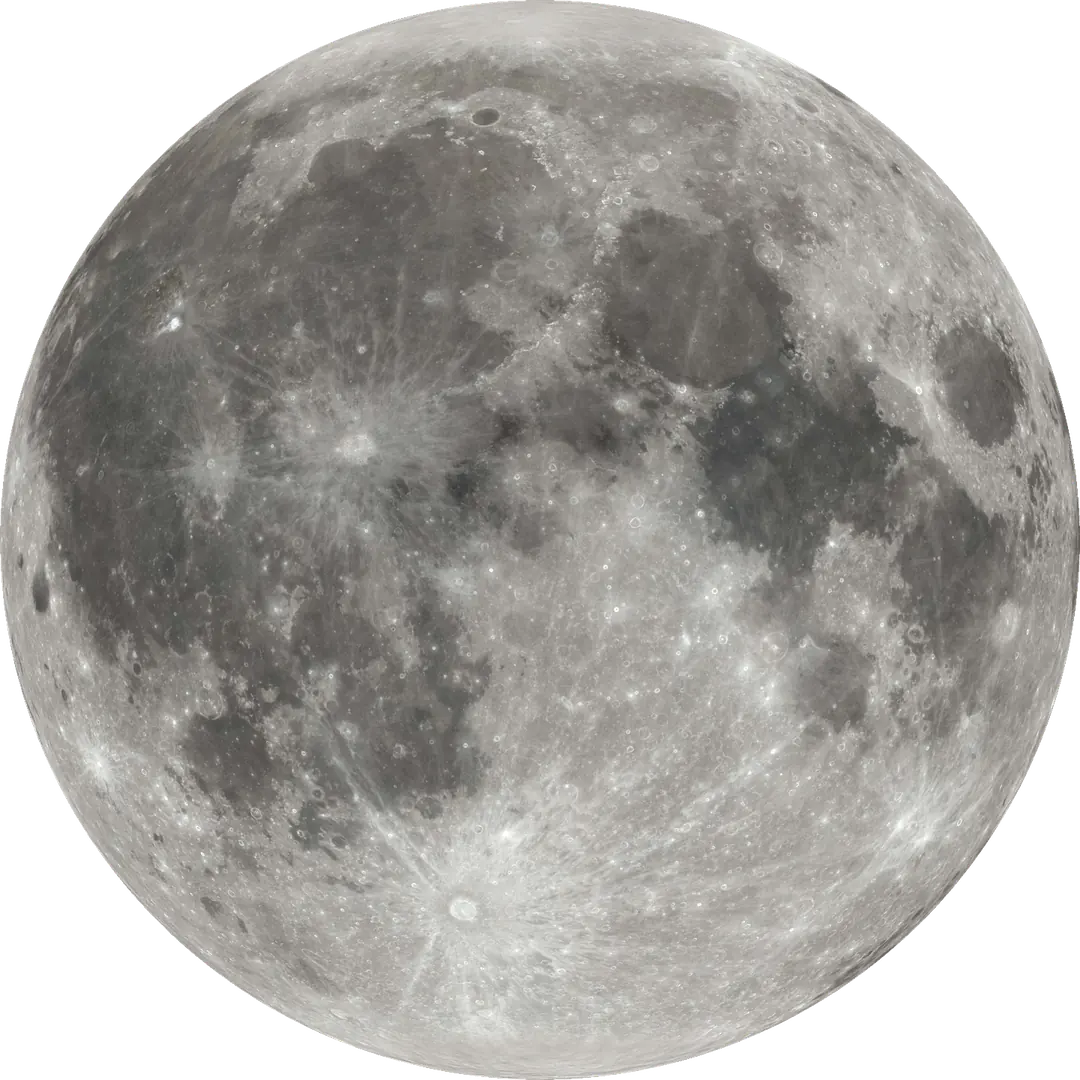
The next Pink Moon is full on . The Pink Moon is the full moon of April in the traditional North American almanac naming, named for a pink spring wildflower rather than the Moon’s color.
When is the Pink Moon?
The Pink Moon is the full moon that falls in April by Coordinated Universal Time (UTC), and the table below lists the upcoming dates with local times.
The full moon is one instant, so its local date depends on the time zone. A Pink Moon early on April 1 in UTC is still a March 31 full moon in New York. A late-April full moon can fall on May 1 in Sydney. This site names each full moon by its UTC month and lists New York, London and Sydney times beside the UTC time.
For the very next full moon of any month, see the next full moon.
The Pink Moon is the fourth of the twelve full moon names used by the Farmers’ Almanac and the Old Farmer’s Almanac.
Key facts
- The Pink Moon is the full moon of April; this site assigns the name by the UTC date.
- The name comes from Phlox subulata, also called creeping phlox, moss phlox or moss pink.
- The Moon does not look pink; a low moon can look yellow, orange or reddish from the atmosphere.
- The Pink Moon usually shines in Virgo, often within 10° of the bright star Spica.
Full moon time around the world
The Pink Moon is full at the same instant everywhere, 22:27 UTC on Tuesday, April 20, 2027, which is 6:27 PM on April 20 in New York and 8:27 AM on April 21 in Sydney.
Los Angeles
15:27
Tue 20 Apr · PDT
New York
18:27
Tue 20 Apr · EDT
London
23:27
Tue 20 Apr · GMT+1
Your time
22:27
Tue 20 Apr · UTC
Delhi
03:57
Wed 21 Apr · GMT+5:30
Sydney
08:27
Wed 21 Apr · GMT+10
Why is it called the Pink Moon?
The Pink Moon is named after Phlox subulata, a wildflower native to eastern North America that blooms in pink masses in early spring.
The Old Farmer’s Almanac gives the plant’s common names as creeping phlox and moss phlox. Its full moon names list calls the flower “moss pink,” one of the first spring wildflowers. The Farmers’ Almanac describes moss pink as a low-growing wild phlox that blankets meadows and roadside banks across eastern North America.
The name marks a season, not a sky color. Spring planting traditions follow the same calendar; gardening by the moon explains how lunar planting guides use the phases.
Does the Pink Moon look pink?
No, the Pink Moon looks gray-white when high in the sky, like every other full moon.
The Old Farmer’s Almanac notes that the Moon’s true color is gray, and that it appears in whatever color Earth’s atmosphere gives it. Near the horizon, moonlight passes through the densest layers of the atmosphere. That longer path can make a rising Pink Moon look yellow, orange or reddish for a short time.
The Moon turns a deeper red only during a total lunar eclipse, often called a blood moon. That happened at the Pink Moon of April 15, 2014, which was a total lunar eclipse. The eclipse color comes from sunlight bent through Earth’s atmosphere, not from the flower name.
Other names for the April full moon
Other names for the April full moon include the Sprouting Grass Moon, Egg Moon, Fish Moon and Breaking Ice Moon, and they describe melting ice, returning birds, spawning fish and the first green growth of spring.
The Old Farmer’s Almanac lists these names with the peoples it credits:
- Breaking Ice Moon (Algonquin)
- Broken Snowshoe Moon and Sucker Moon (Anishinaabe)
- Budding Moon of Plants and Shrubs (Tlingit)
- Frog Moon (Cree)
- Moon of the Red Grass Appearing (Oglala)
- Moon When the Ducks Come Back (Lakota)
- Moon When the Geese Lay Eggs and Moon When the Streams Are Again Navigable (Dakota)
- Sugar Maker Moon (Western Abenaki)
timeanddate and the Farmers’ Almanac also list Sprouting Grass Moon, Egg Moon and Fish Moon. Christian tradition uses the name Paschal Moon for the first full moon of spring, which sets the date of Easter and is often the April full moon.
Where is the Pink Moon in the sky?
The next Pink Moon, on , is in the constellation Virgo. The Pink Moon almost always shines in Virgo, and in about seven of every ten years it passes within 10° of Spica, the constellation’s brightest star.
The Pink Moon rises south of due east around sunset, as seen from the Northern Hemisphere. At the latitude of New York, it peaks about 31–47° above the southern horizon, lower than a winter full moon. At London’s latitude it reaches about 20–36°. It stays up for about 10–12 hours in New York.
Around the Pink Moon, moonrise comes about 55–80 minutes later each evening at New York’s latitude, well above the 50-minute average. The Moon therefore rises noticeably later on each evening after the full moon, leaving the early evening sky dark again within a few days.
The Farmers’ Almanac points to orange Arcturus in Boötes and blue-white Spica in Virgo as the anchors of the April evening sky. Both stars help locate the Pink Moon’s neighborhood once the Moon has risen.
The Pink Moon in the Southern Hemisphere
In the Southern Hemisphere the Pink Moon is a mid-autumn full moon, so its spring flower name does not match the season there.
Seen from Sydney, the April full moon climbs high in the northern sky, about 59–74° above the horizon, and stays up for about 13 hours. Moonrise around the April full moon comes only about 25–55 minutes later each evening in Sydney, part of the Southern Hemisphere’s autumn version of the Harvest Moon effect.
The full moon before it is March’s Worm Moon. The next is May’s Flower Moon, named for the wider bloom of late spring in North America.