
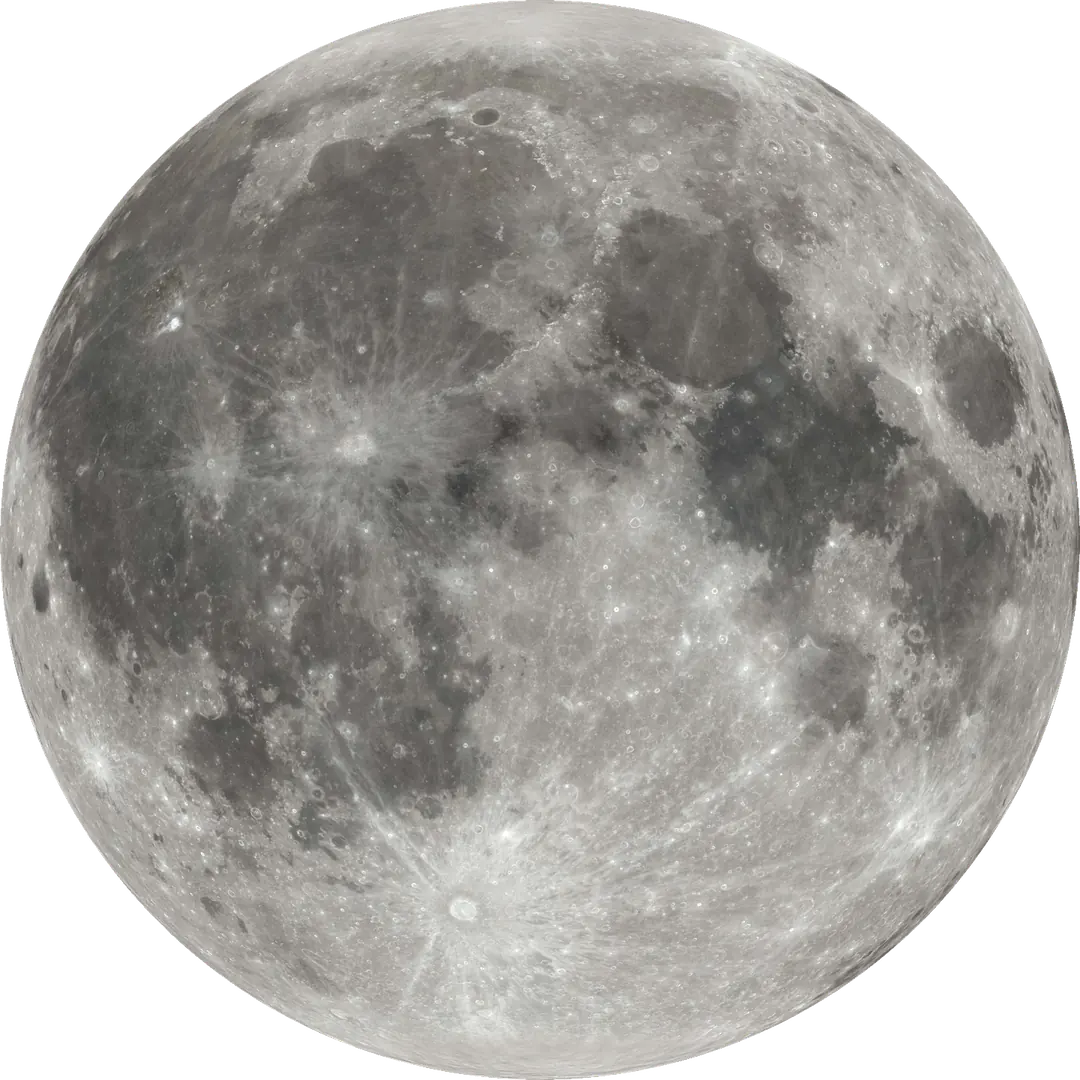
The next Flower Moon is full on . The Flower Moon is the full moon of May in the traditional North American almanac naming, named for the wildflowers that bloom in abundance in late spring.
When is the Flower Moon?
The Flower Moon is the full moon that falls in May by Coordinated Universal Time (UTC), and the table below lists the upcoming dates with local times.
The full moon is one instant, so its local date depends on the time zone. A Flower Moon early on May 1 in UTC is still an April 30 full moon in New York. A late-May full moon can fall on June 1 in Sydney. This site names each full moon by its UTC month and lists New York, London and Sydney times beside the UTC time.
May has 31 days, so it can hold two full moons. May 2026 had full moons on May 1 and May 31, and the second was a monthly Blue Moon. For the very next full moon of any month, see the next full moon.
The Flower Moon is the fifth of the twelve full moon names used by the Farmers’ Almanac and the Old Farmer’s Almanac.
Key facts
- The Flower Moon is the full moon of May; this site assigns the name by the UTC date.
- The Old Farmer's Almanac attributes the name to Algonquin peoples.
- Other names include Planting Moon, Corn Planting Moon, Milk Moon and Budding Moon.
- May 2026 had two Flower Moons, on May 1 and May 31, and the second was a Blue Moon.
Full moon time around the world
The Flower Moon is full at the same instant everywhere, 10:59 UTC on Thursday, May 20, 2027, which is 6:59 AM on May 20 in New York and 8:59 PM on May 20 in Sydney.
Los Angeles
03:59
Thu 20 May · PDT
New York
06:59
Thu 20 May · EDT
London
11:59
Thu 20 May · GMT+1
Your time
10:59
Thu 20 May · UTC
Delhi
16:29
Thu 20 May · GMT+5:30
Sydney
20:59
Thu 20 May · GMT+10
Why is it called the Flower Moon?
The Flower Moon is named for the flowers that spring up across North America in abundance during May.
The Old Farmer’s Almanac attributes the name to Algonquin peoples, as confirmed by Christina Ruddy of The Algonquin Way Cultural Centre in Pikwakanagan, Ontario. It also notes that Jonathan Carver recorded a “Month of Flowers” in his book Travels Through the Interior Parts of North America, as a likely Dakota name. Henry David Thoreau later referred to the Flower Moon when he wrote about Native Americans.
The Farmers’ Almanac describes the bloom behind the name: lupines and columbines on hillsides, wild iris in damp ditches and trillium under the trees. It adds that the name persisted through colonial American almanacs.
Other names for the May full moon
Other names for the May full moon include the Milk Moon, Corn Planting Moon, Planting Moon and Frog Moon, and they describe budding leaves, planting, egg laying and the return of frogs.
The Old Farmer’s Almanac lists these names with the peoples it credits:
- Budding Moon and Leaf Budding Moon (Cree)
- Egg Laying Moon and Frog Moon (Cree)
- Planting Moon (Dakota and Lakota)
- Moon of the Shedding Ponies (Oglala)
The Farmers’ Almanac adds Corn Planting Moon, which it credits to nations of the Great Plains and Midwest. It also lists Milk Moon, which it ties to European dairy tradition and peak milk yields on spring pasture. timeanddate lists both of these alternative names as well.
The Farmers’ Almanac also includes Hare Moon, which it traces to Anglo-Saxon tradition, and Mother’s Moon, a modern American name tied to Mother’s Day. Planting names connect this full moon to gardening by the moon, a tradition that times sowing to the lunar phases.
Where is the Flower Moon in the sky?
The next Flower Moon, on , is in the constellation Libra. The Flower Moon rides low in the Northern Hemisphere sky, usually in Libra or Scorpius, and in about three of every ten years it passes within 10° of the red supergiant Antares.
A full moon sits opposite the Sun, and the late-spring Sun climbs high, so the May full moon takes a low path. At the latitude of New York, the Flower Moon peaks only about 23–37° above the southern horizon. At London’s latitude it reaches about 12–26°. It rises south of due east around sunset and sets south of due west around sunrise.
Short late-spring nights keep the Flower Moon above the horizon for about 9–11 hours in New York and about 9 hours in London. A low full moon also passes through more of the atmosphere, so it can keep a yellow or orange tint longer than a high winter full moon.
Flower Moons and lunar eclipses
Two recent Flower Moons were total lunar eclipses, on May 26, 2021 and May 16, 2022.
A lunar eclipse happens only at full moon, when the Moon passes through Earth’s shadow near a node of its tilted orbit. The eclipse of May 26, 2021 was also a supermoon, with the Moon about 357,500 km (222,100 mi) from Earth. Eclipse seasons recur about every 173 days, so they shift through the calendar and leave May for many years at a time.
The Flower Moon in the Southern Hemisphere
In the Southern Hemisphere the Flower Moon is a late-autumn full moon, so its name does not match the season there.
Seen from Sydney, the May full moon climbs very high in the northern sky, about 69–83° above the horizon. It stays up for about 14 hours, because late-autumn nights there are long. The full moon before it is April’s Pink Moon. The next is June’s Strawberry Moon, usually the lowest full moon of the year as seen from the Northern Hemisphere.