
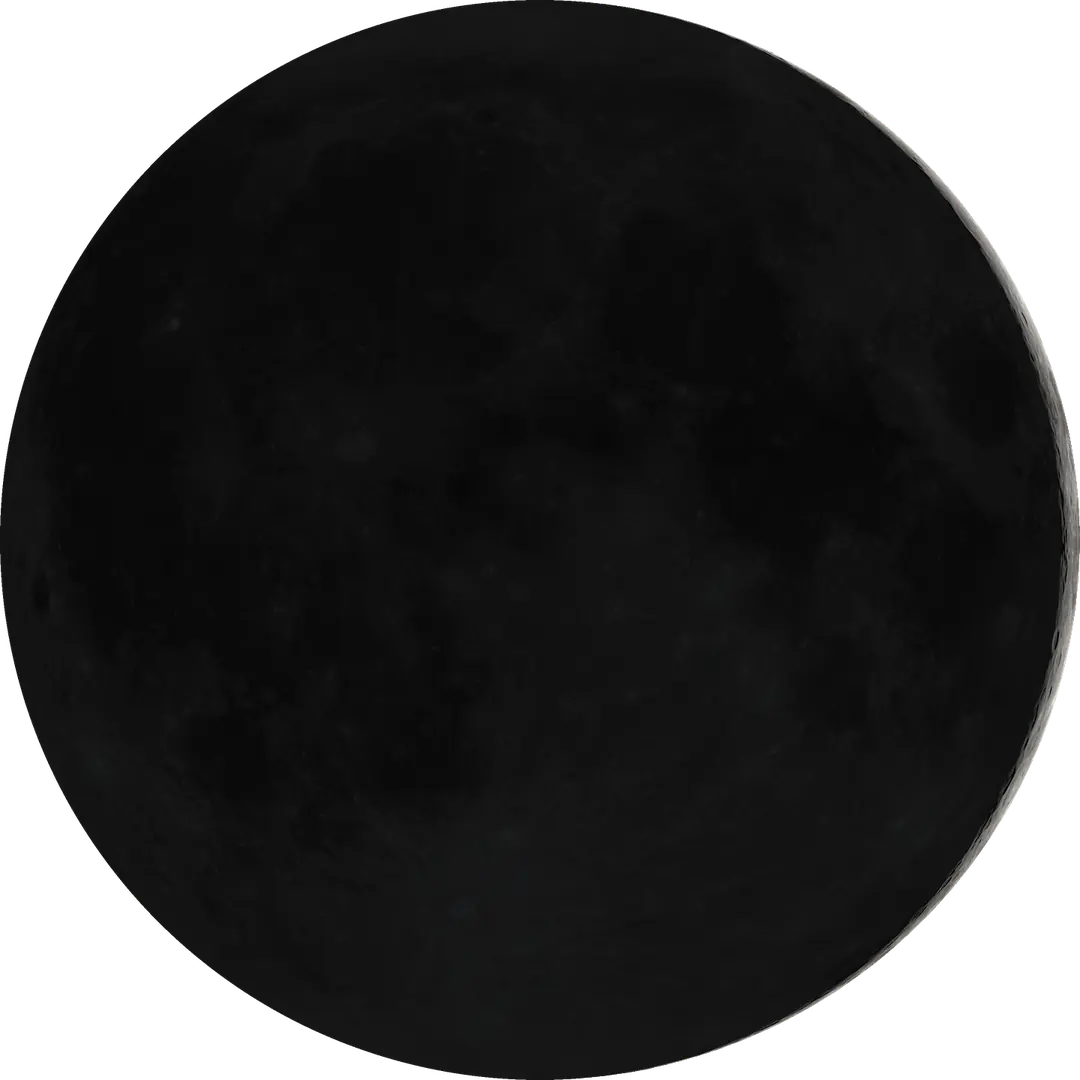
A new moon is the instant when the Moon and the Sun share the same ecliptic longitude, so the Moon’s sunlit side faces away from Earth and the Moon cannot be seen. New moons come every 29.53 days on average, 12 or 13 times a year. Each new moon starts a new lunar cycle.
What is a new moon?
A new moon is the moment of conjunction, when the Moon lines up with the Sun in ecliptic longitude on the same side of Earth. The Sun then lights the Moon’s far side, and the side facing Earth is dark. The new moon is the first of the eight phases, and the lunar cycle from one new moon to the next lasts 29.53 days on average.
The Moon rarely passes directly in front of the Sun at new moon. The Moon’s orbit is tilted 5.14° to Earth’s orbit, so at most new moons the Moon slips up to about 5° north or south of the Sun. Only when the alignment is close enough does a new moon become a solar eclipse.
The opposite phase, the full moon, comes about 15 days later. The countdown to the next full moon shows its date, name and time.
When is the next new moon?
The next new moon is on , and the one after it is on .
Both times are in UTC. The new moon is one instant for the whole planet, so the local date can differ by a day: a new moon late in the UTC day falls on the next date in Asia and Australia. This site calls a calendar day a new moon day when the new moon instant falls inside that day.
Why can’t you see the new moon?
You cannot see the new moon because its lit side faces away from Earth and it sits in the same part of the sky as the Sun. NASA describes the new moon as the phase in which the Moon rises and sets with the Sun. Its faint, dark side is lost in the daytime glare.
Two things make a new moon visible. During a solar eclipse, the dark disc of the Moon shows up as it covers the Sun. A day or two after new moon, a thin crescent appears once the Moon has moved far enough from the Sun.
When does the first crescent appear after a new moon?
The first thin crescent appears low in the west just after sunset, usually within a few evenings of the new moon. HM Nautical Almanac Office advises looking just after sunset over the three or four days that follow the instant of new moon.
The crescent is hard to catch at first. A day after new moon, the Moon is on average only about 13° from the Sun and about 1% lit. Two days after, it is about 25° from the Sun and about 5% lit, and it sets later in a darker sky. Cloud, haze, latitude and a low horizon all affect when it first shows.
As seen from the Northern Hemisphere, this young waxing crescent is lit on its right side; from the Southern Hemisphere it is lit on the left. Before the new moon the pattern is reversed. The last waning crescent shows low in the east just before sunrise, lit on the opposite side, a day or two before the new moon.
Why do solar eclipses happen only at new moon?
A solar eclipse can happen only at new moon, because that is the only time the Moon passes between Earth and the Sun. Most new moons miss, since the Moon’s 5.14° tilt carries it above or below the Sun. Eclipses become possible only in eclipse seasons, which recur about every 173 days, when the new moon falls close to the line where the two orbits cross.
| Greatest eclipse (UTC) | Type | Point of greatest eclipse |
|---|---|---|
| , 15:59 | Annular | South America (31.3°S, 48.5°W) |
| , 10:06 | Total | North Africa (25.5°N, 33.2°E) |
| , 15:07 | Annular | South America (3.0°N, 51.5°W) |
| , 02:55 | Total | Australia (15.6°S, 126.7°E) |
The same geometry, half a cycle later, produces lunar eclipses at full moon. The guide to lunar vs solar eclipse compares the two side by side.
Why is the new moon the best time for stargazing?
The new moon is the best time for stargazing because the Moon is up only during daylight and adds no light to the night sky. Faint stars, the Milky Way and deep-sky objects stand out best in that darkness.
The dark window lasts longer than one night. A few days before new moon, the waning crescent rises only shortly before dawn. A few days after, the waxing crescent sets soon after dusk. For planning, the guide to the best moon phase for stargazing shows when the Moon is out of the night sky.
Which calendars begin their months at the new moon?
Lunar and lunisolar calendars start their months at or just after the new moon. Two widely used examples:
- The Chinese calendar. Chinese New Year falls on a new moon, usually the new moon closest to Lìchūn, the traditional start of spring, and always between January 21 and February 21.
- The Islamic calendar. Months traditionally begin with the first sighting of the new crescent. The crescent seen after Ramadan marks the end of the fast and the start of Eid al-Fitr.
These calendars explain why holidays such as Chinese New Year and Eid move from year to year in the Gregorian calendar.
What does the new moon mean in astrology?
In astrology the new moon is associated with beginnings, and many astrologers treat it as a time to set intentions. These are beliefs, not effects that astronomy measures.
Astronomy explains one detail: at new moon the Moon and the Sun share the same ecliptic longitude, so the new moon always falls in the same zodiac sign as the Sun. A person’s moon sign usually differs from their sun sign, because the Moon changes sign about every 2.5 days. A moon sign calculator finds the sign the Moon occupied at the moment of birth.