
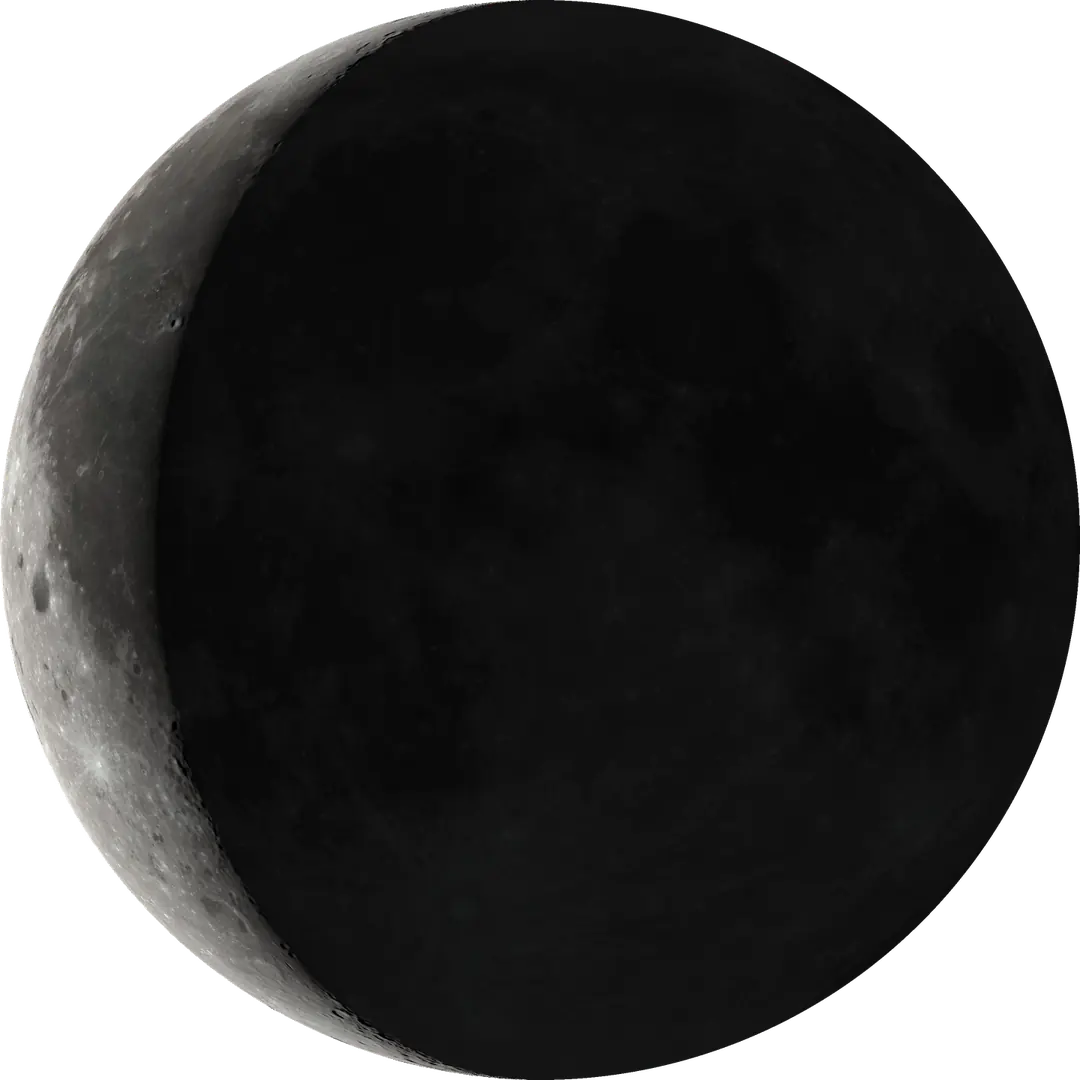
A waning crescent is the last Moon phase before the new moon, when 49–1% of the Moon’s visible face is lit and the lit part shrinks each morning. The phase lasts about 7.4 days and is seen in the eastern sky before sunrise.
Key facts
- Lasts about 7.4 days on average, from last quarter to new moon.
- Lit on the left as seen from the Northern Hemisphere, on the right as seen from the Southern Hemisphere.
- Rises in the early morning before the Sun and sets in the afternoon.
- Often called the old moon; earthshine can light its dark part before dawn.
What is a waning crescent moon?
The waning crescent is the eighth and final phase of the Moon’s cycle, a shrinking morning curve of light that many people never notice.
“Waning” means the lit part is getting smaller, and “crescent” means less than half of the disc is lit. The phase begins just after the last quarter moon, when the Moon is 90° west of the Sun. It ends at the new moon, when the Moon passes between Earth and the Sun. Each day the Moon moves about 12° closer to the Sun in the sky, so the crescent thins from almost half a disc to a thread of light. The full sequence of the phases of the moon shows the waning crescent closing the 29.5-day cycle.
The waning crescent is often called the old moon. It stays “old” until the moment it lines up with the Sun at new moon, when the cycle starts again.
What does a waning crescent look like?
As seen from the Northern Hemisphere, a waning crescent is a thin curve of light on the left side of the Moon, with its horns pointing right, away from the Sun.
The lit edge always points toward the Sun, which is below the eastern horizon before dawn. That makes the bright edge of a waning crescent point east, toward sunrise, in both hemispheres. From the Southern Hemisphere, the crescent is lit on the right, because observers there see the Moon rotated by about 180°. Near the equator, the morning crescent often lies almost flat, with its horns pointing up.
The shape mirrors the waxing crescent of the evening sky. The quickest way to tell which of the two crescents you are looking at is the time of day, as explained in waxing vs waning.
When does a waning crescent rise and set?
A waning crescent rises in the very early morning, before sunrise, and sets in the afternoon, before sunset.
| Days before new moon | Lit (approx.) | Rises (approx.) | Sets (approx.) |
|---|---|---|---|
| 7 | 45% | 6 hours before sunrise | 6 hours before sunset |
| 5 | 25% | 4 hours before sunrise | 4 hours before sunset |
| 3 | 10% | 2.5 hours before sunrise | 2.5 hours before sunset |
| 1 | 1% | 50 minutes before sunrise | 50 minutes before sunset |
These values are averages. The Moon rises about 50 minutes later each day, so the crescent rises closer to sunrise every morning. The daily delay ranges from about 30 to 70 minutes at mid-latitudes, depending on the season.
The best time to look is in the hour or two before sunrise, toward the east. After sunrise the crescent stays above the horizon until the afternoon, west of the Sun. A thicker crescent early in the phase is easy to pick out in the morning sky, which is why you can see the moon during the day on many mornings after last quarter.
How long does the waning crescent phase last?
The waning crescent phase lasts about 7.4 days on average, from the instant of last quarter to the instant of new moon.
The length ranges from roughly 6.6 to 8.2 days, because the Moon moves faster near perigee and slower near apogee. On a calendar, the last quarter day and the new moon day carry those names, so a waning crescent usually fills about 6 calendar days in between.
When is the next waning crescent?
The next waning crescent begins just after the next last quarter, which falls on .
It then shrinks for about 7.4 days, until the new moon that follows. When a waning crescent is already in the sky, it ends at the next new moon, on . The page for the next new moon explains what happens when the Moon disappears between the crescents.
Why do fewer people see the waning crescent?
Fewer people see the waning crescent because it is a morning moon: it rises in the small hours, is highest around dawn and fades into the daylight sky.
The waxing crescent appears at a convenient hour, in the west after sunset, when many people are outdoors. The waning crescent needs an early start. Early in the phase it rises around midnight, and late in the phase it rises less than an hour before the Sun. Late in the phase it also sits low in the brightening east. Anyone who looks east in the hour before dawn during the last week of the cycle has a good chance of seeing it.
What can you see on a waning crescent?
A waning crescent shows earthshine on its night side and long shadows along the terminator, where the Sun is setting on the Moon.
Earthshine before dawn
Earthshine is sunlight reflected from Earth onto the Moon’s night side and back to our eyes. It makes the dark part of a crescent glow faintly, and it is easiest to see a few days before or after new moon. When the Moon is a thin crescent in our sky, an observer on the Moon would see a nearly full Earth. Leonardo da Vinci explained the glow in the early 16th century, when he realized that Earth and the Moon both reflect sunlight.
Sunset along the terminator
On a waning moon, the terminator marks where lunar night is falling. Crater rims and mountains near it cast long shadows, and each morning a band of the surface about 12° of lunar longitude wide slips into darkness. Binoculars show the shadows well against the dawn sky.
Dark evening skies
A waning crescent is below the horizon for the whole evening, so the sky stays dark from dusk until the Moon rises in the small hours. That makes the last week of the cycle one of the best periods for faint stars and the Milky Way, as the guide to the best moon phase for stargazing explains.