
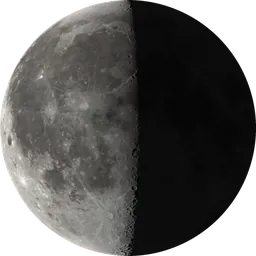
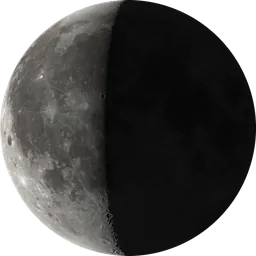
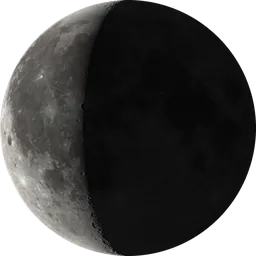
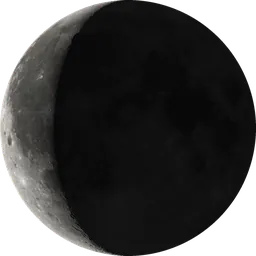
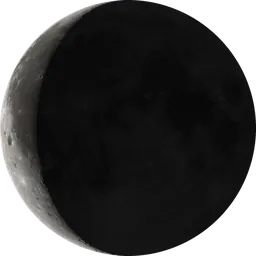
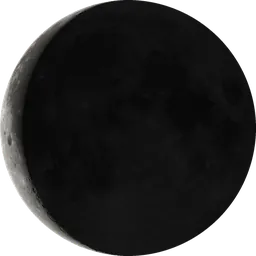
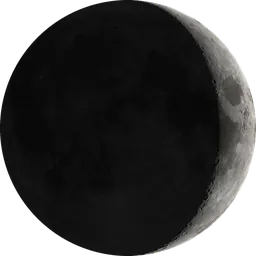
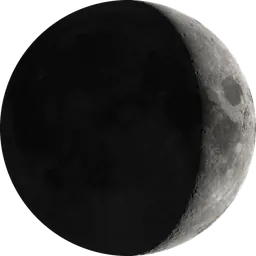
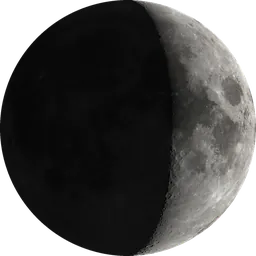
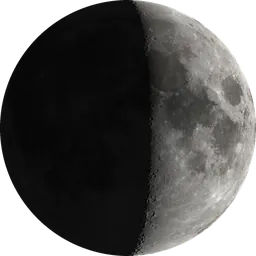
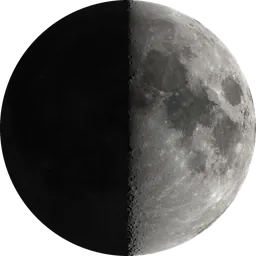
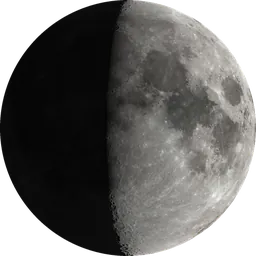
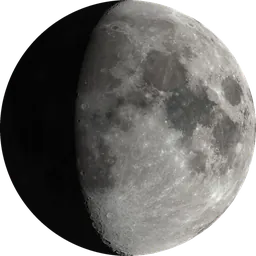
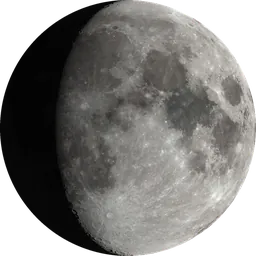
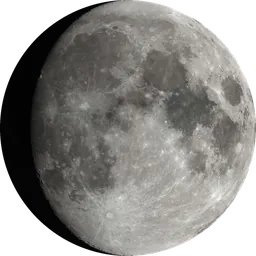
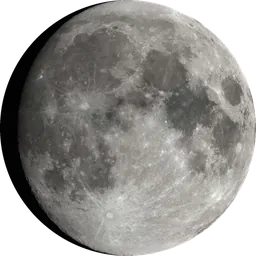
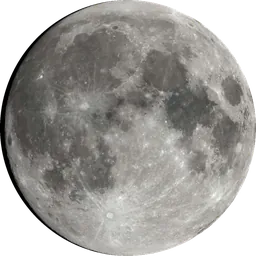
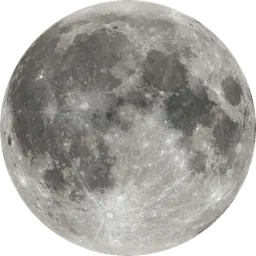
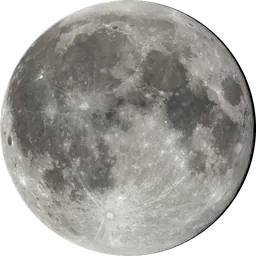
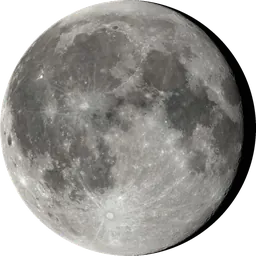
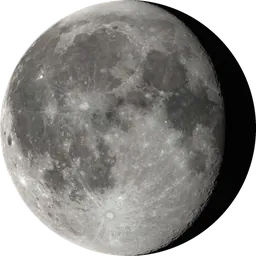
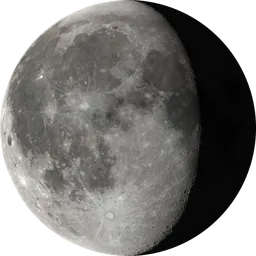
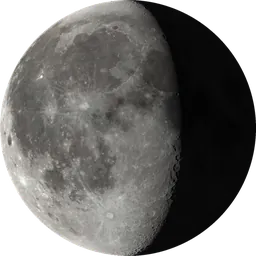
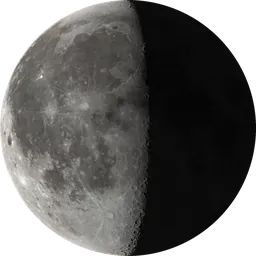
A moon phase calendar is a calendar that shows the Moon’s phase on every day, with the exact date and time of each new moon, first quarter, full moon and last quarter. The calendar above shows the current month and an overview of the next 12 months, and it links to full-year calendars for 2026 and 2027 that you can print.
How do you read a moon phase calendar?
Each day on a moon phase calendar carries a small drawing of the Moon’s lit part, and the four primary phases are marked with their exact time. The drawings are north-up, the standard view from the Northern Hemisphere, so the lit side grows from the right toward full moon and shrinks to a sliver on the left before the next new moon.
Primary and intermediate phases
Primary phases are the four instants that divide each cycle into quarters: new moon, first quarter, full moon and last quarter. They occur when the difference between the Moon’s and the Sun’s ecliptic longitude reaches 0°, 90°, 180° and 270°, and they come on average 7.4 days apart.
Intermediate phases are the stretches between them: waxing crescent, waxing gibbous, waning gibbous and waning crescent. On this site, a calendar day takes a primary phase’s name when the primary instant falls inside that day, and every other day takes the name of the intermediate phase it sits in. The guide to the phases of the moon shows what each one looks like, and the live moon phase today page shows where the cycle stands right now.
UTC or local time?
Moon calendars on this site use Coordinated Universal Time (UTC) unless they say otherwise, which keeps one date for each phase worldwide. A primary phase near midnight UTC can fall on a different local date. A full moon at 01:00 UTC is still the previous evening in North America, and one at 23:00 UTC is already the next morning in Australia.
Moon phase calendars for 2026 and 2027
The year calendars collect a whole year on one page, with the exact UTC time of every primary phase. The moon calendar 2026 and the moon calendar 2027 each include a print view, and every month of both years also has its own page.
The grid below shows January 2027 as an example, and the page on moon phases in January 2027 holds the same month with its phase dates.
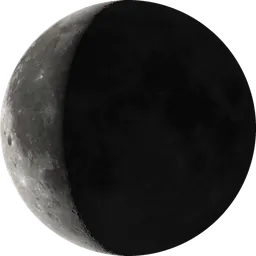
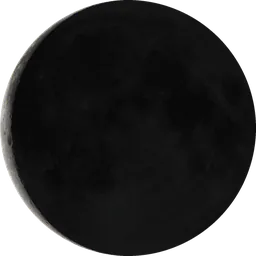
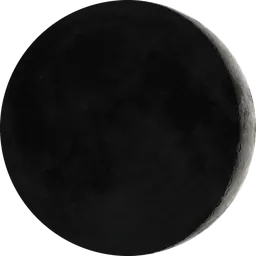
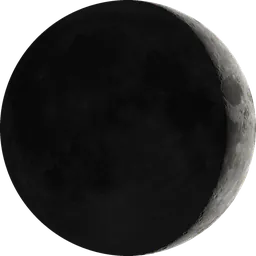
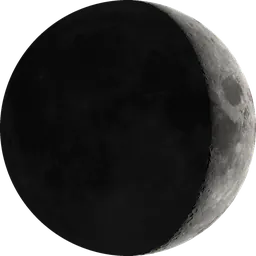
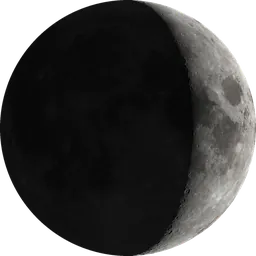
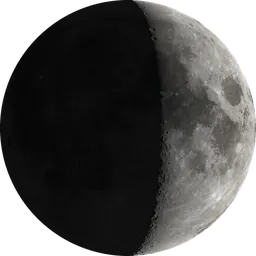
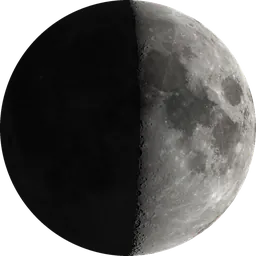
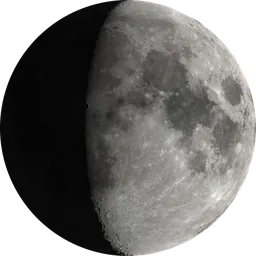
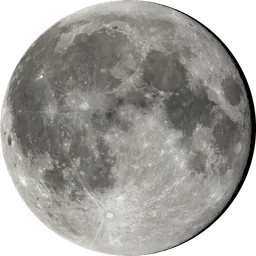
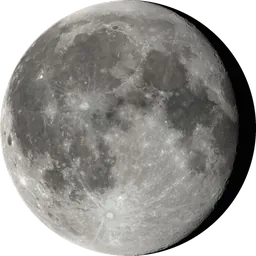
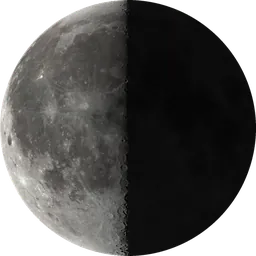
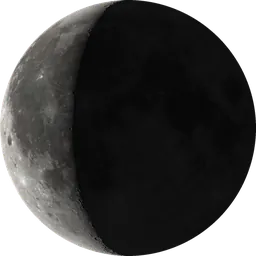
Phases for each UTC day; primary phases are marked on the day their exact instant falls.
The grid uses UTC dates, so each drawing shows the Moon at the middle of that UTC day.
When are the next full moons?
The next 12 full moons are listed below with their UTC date and time, their traditional name and flags for supermoons, Blue Moons and lunar eclipses.
| Date & time (UTC) | Name | Distance | Notes |
|---|---|---|---|
| , 14:54 | Beaver Moon | 360,754 km | Supermoon |
| , 01:28 | Cold Moon | 356,729 km | Closest supermoon of the year |
| , 12:17 | Wolf Moon | 357,635 km | Closest supermoon of the year |
| , 23:24 | Snow Moon | 363,296 km | SupermoonPenumbral lunar eclipse |
| , 10:44 | Worm Moon | 372,518 km | |
| , 22:27 | Pink Moon | 383,421 km | |
| , 10:59 | Flower Moon | 393,893 km | Blue Moon (seasonal) |
| , 00:45 | Strawberry Moon | 401,943 km | Micromoon |
| , 15:45 | Buck Moon | 405,968 km | MicromoonPenumbral lunar eclipse |
| , 07:29 | Sturgeon Moon | 405,069 km | MicromoonPenumbral lunar eclipse |
| , 23:04 | Harvest Moon (also Corn Moon) | 399,341 km | |
| , 13:47 | Hunter's Moon | 389,926 km |
The names come from North American almanac tradition, and the guide to full moon names traces them month by month. The next full moon page covers the nearest one in detail.
The supermoon flag marks a full moon within 90% of the Moon’s closest approach for that orbit, following Richard Nolle’s definition. A full moon can happen anywhere from about 356,400 km to about 406,700 km (221,500 to 252,700 mi) from Earth, so a supermoon can look up to about 14% larger and 30% brighter than a micromoon, a full moon near the far point of the orbit.
How many full moons are there in a year?
A calendar year has 12 or 13 full moons. Twelve lunar cycles last about 354.4 days, which leaves roughly 11 days of the year for a 13th full moon, so a year has 13 when its first full moon falls in about the first 11 days of January.
The 19-year Metonic cycle shows how often that happens. Nineteen years hold 235 full moons, which is 7 more than 19 × 12, so 7 years in every 19 have 13 full moons, a little more than one year in three.
In a year with 13 full moons, at least one calendar month must hold two of them. The second full moon in a calendar month is a monthly Blue Moon. A separate, seasonal definition counts the third of four full moons in one astronomical season instead.
Why do moon phases fall on different dates every year?
Moon phases fall on different dates every year because 12 lunar cycles, about 354.4 days, are roughly 11 days shorter than a calendar year. Each phase therefore arrives about 11 days earlier than in the year before, or about 18 to 19 days later when a 13th lunar cycle fits into the gap.
The dates line up again after 19 years, the length of the Metonic cycle. In that time there are 235 lunar cycles, which last 6,939 days and 16.5 hours, against 6,939 days and 14.5 hours for 19 years of seasons. A full moon on a given date is therefore usually followed by a full moon on the same date, or within a day of it, 19 years later.
The same drift explains why a full moon name does not stay on one date. The Harvest Moon, the full moon nearest the September equinox, can fall in either September or October depending on where the cycle stands that year.
What is the difference between lunar, lunisolar and solar calendars?
A lunar calendar counts months by the Moon alone, a lunisolar calendar uses lunar months but adds a leap month to stay in step with the seasons, and a solar calendar follows the seasons and ignores the Moon.
| Calendar | Type | How months work | Year length and leap rule |
|---|---|---|---|
| Gregorian | Solar | Months of 28 to 31 days, not tied to the Moon | 365 days, 366 in leap years |
| Islamic (Hijri) | Lunar | 12 months of 29 or 30 days, traditionally starting with the sighting of the young crescent | 354 or 355 days, so the months move through all the seasons in about 32.5 years |
| Hebrew | Lunisolar | Months tied to the new moon | Adds a 13th month, Adar I, in 7 of every 19 years |
| Chinese | Lunisolar | Months begin on the day of the new moon | Adds a leap month about once every 2.7 years; New Year usually falls on the second new moon after the winter solstice |
A moon phase calendar like the one above is not a calendar system of its own. It lays the Moon’s phases over the Gregorian calendar, which is why the phases land on different dates each year.
The two lunisolar calendars keep pace with the seasons by adding, on average, 7 leap months every 19 years, the same 235-month Metonic cycle. Every one of these calendars rests on the lunar cycle, which averages 29.53 days from new moon to new moon. In everyday English, “lunar calendar” often just means a moon phase calendar like this one.
How do you use a moon calendar for gardening?
Gardeners who follow the tradition of planting by the Moon use a moon calendar to time sowing, transplanting and pruning by the Moon’s phase or zodiac sign. These are traditional rules, and they differ between traditions.
The guide to gardening by the moon sets out the common rules and keeps its own day-by-day planting calendar. The phase calendar above supplies the dates those rules depend on: when the Moon is waxing, when it is waning and when each primary phase falls.
How do you plan stargazing, photography and fishing with a moon calendar?
A moon calendar shows at a glance which nights will be dark, which will be bright and roughly when the Moon will rise, which is what most outdoor plans depend on.
- Stargazing: the darkest nights fall in the days around new moon, when the Moon is close to the Sun and out of the night sky. Around full moon, the Moon’s glare (apparent magnitude about −12.7) washes out the Milky Way and faint galaxies. The next new moon page gives the date, and the guide to the best moon phase for stargazing explains how to plan a session.
- Photography: thin crescents in twilight show earthshine on the dark part of the disc. A full moon rises around sunset, so it can be photographed above a landscape still lit by the Sun. Quarter moons show the most crater relief along the line between light and shadow.
- Fishing and the coast: spring tides, with the largest range between high and low water, occur around new and full moon. Neap tides, with the smallest range, occur around the first and last quarter. Anglers who keep a log can record the phase alongside the tide tables.
- Evening events: a Moon a few days before full is already up at sunset and stays up most of the evening, which suits outdoor gatherings.
Can you print a moon phase calendar?
Yes: the 2026 and 2027 year calendars each have a print view that fits the whole year on paper. Open the year page, choose the print view and print it, or save it as a PDF from your browser’s print dialog.
Because calendar dates on this site are in UTC, readers in the Americas should check any phase that falls shortly after midnight UTC, since it belongs to the previous local evening. Readers in Asia and Australia should do the same for phases shortly before midnight UTC, which belong to the next local morning.
How do you add moon phases to your phone calendar?
Subscribing to a calendar feed puts the Moon’s phases into the calendar app you already use, in your own time zone, and keeps them updated. Two free feeds are available: “Full moons with names” and “All moon phases”.
Both work with Google Calendar, Apple Calendar and Outlook, and the steps for each are on the page that shows how to add moon phases to your calendar. To check a single day instead of a whole month, look up the moon phase on any date from 1900 to 2100.