
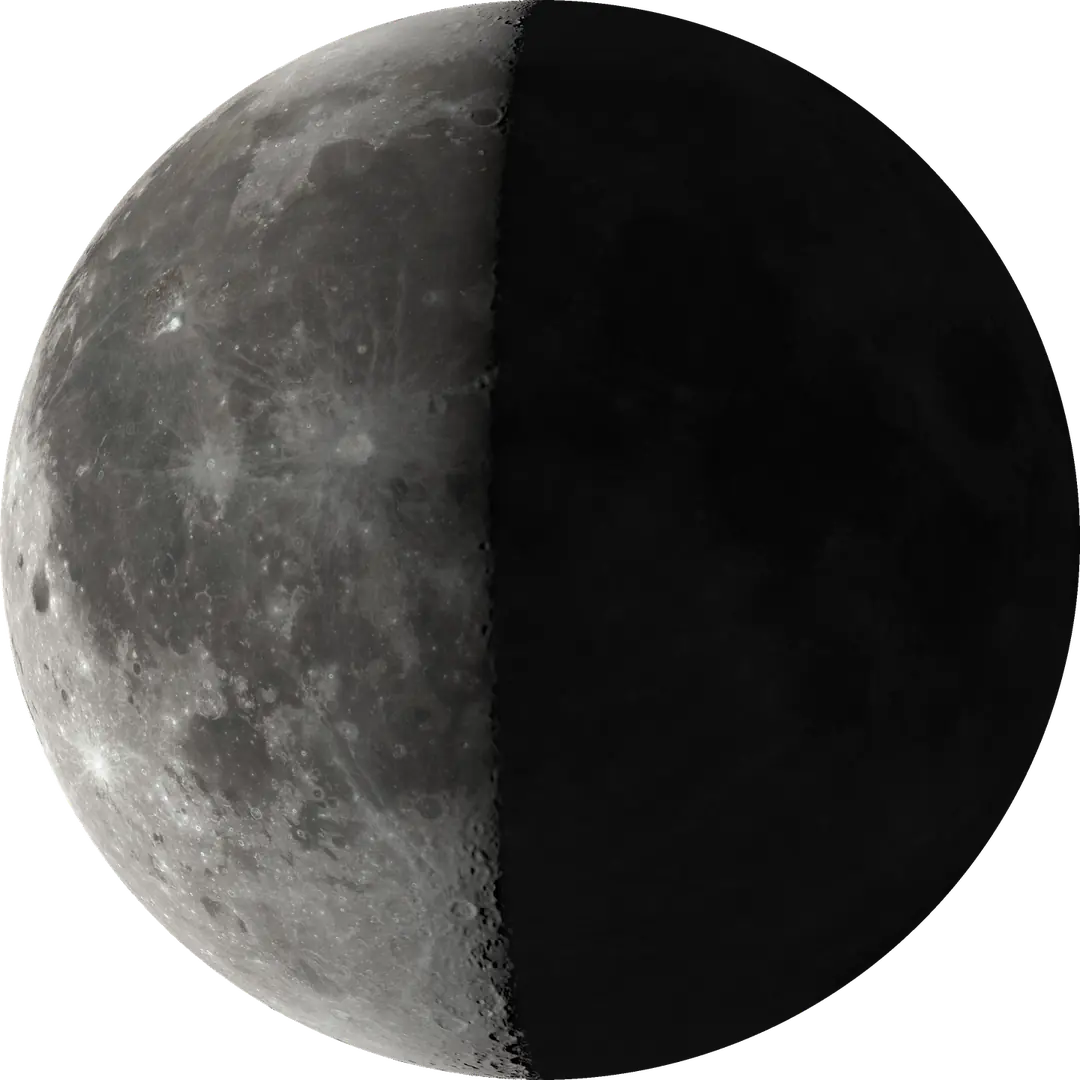
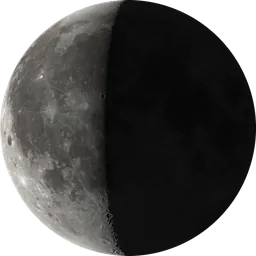
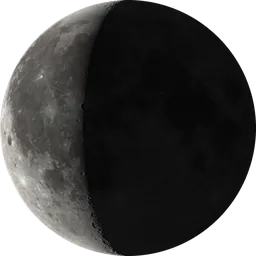
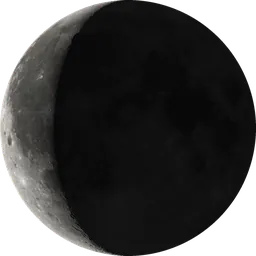
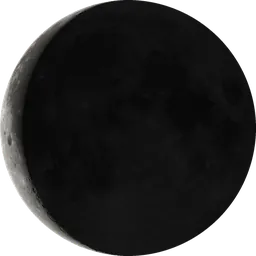
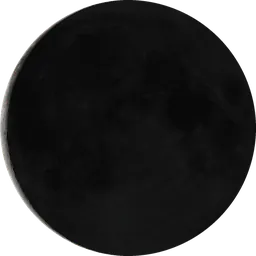
The moon phase today is the Moon’s current place in its 29.53-day cycle, shown in the panel above as a phase name, the percentage of the disc that is lit and the Moon’s age in days. The drawing shows the Moon as it looks from your own sky, with your local moonrise, moonset and highest point underneath. Every value is calculated live for the moment you open the page.
How do you read today’s moon numbers?
The phase name says where the Moon is in its cycle, the illumination says how much of the visible disc is lit, and the age says how many days have passed since the last new moon.
- Phase name. One of eight names. Four of them (New Moon, First Quarter, Full Moon and Last Quarter) are exact instants about 7.4 days apart on average; the other four are the stretches in between.
- Illumination. The share of the Moon’s visible face that is sunlit: 0% at new moon, 50% at the quarters and 100% at full moon.
- Age. Days since the last new moon, from 0 to about 29.5. On average the Moon is 7.4 days old at first quarter, 14.8 at full moon and 22.1 at last quarter.
- Distance. Earth’s center to the Moon’s center: 384,400 km (238,855 mi) on average, ranging from about 356,400 km to 406,700 km. The moon facts page explains why it varies.
- Zodiac sign. The tropical sign the Moon is passing through. The Moon changes sign about every 2.5 days, and the page on what sign the moon is in today gives the next change.
Illumination does not change at a steady rate. It climbs or falls by roughly 10 percentage points a day around the quarters, but barely moves around new and full moon, which is why a full moon looks round for about three nights.
Why is a half-lit Moon called a quarter?
A quarter moon is 50% lit because “quarter” describes how far the Moon has traveled through its cycle, not the shape you see. At first quarter the Moon has completed one quarter of its cycle, and at last quarter three quarters; at both points half of its face is sunlit. The page on the first quarter moon covers the naming in more detail.
Why does the Moon look tilted or upside down where you are?
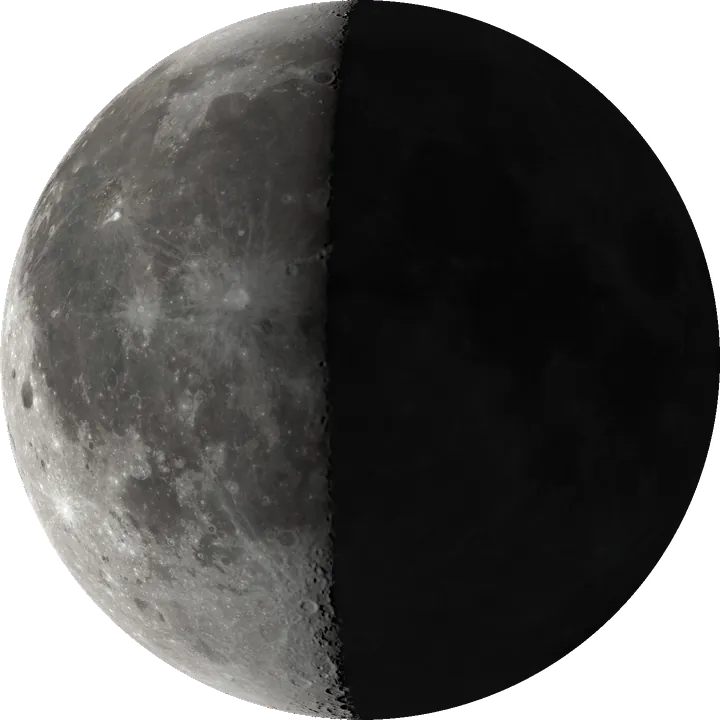
The Moon’s lit side always faces the Sun, but the angle the Moon makes with your horizon depends on your latitude and the time of night, so the panel draws the Moon for your own sky. As seen from the Northern Hemisphere a waxing Moon is lit on the right; from the Southern Hemisphere it appears rotated about 180° and is lit on the left. Near the equator, a low crescent lies almost flat, like a boat.
The phase itself is the same for everyone on Earth at the same instant; only the orientation, the local date and the rise and set times change. The toggle in the panel switches to the north-up view used in NASA images or to the Southern Hemisphere view, and the figure below draws one Moon as seen from London, Singapore and Sydney.
Northern sky · 51.5° N
London
Near the equator · 1.4° N
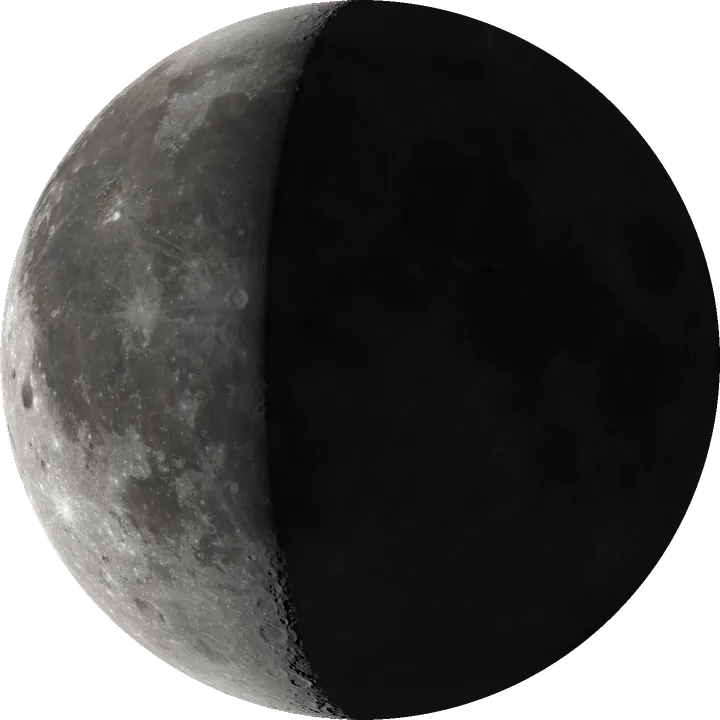
Singapore
Southern sky · 33.9° S
Sydney
The guide to why the moon looks upside down in the southern hemisphere explains the geometry behind the flip.
What will the Moon look like over the next week?
The 7-day strip in the panel shows the coming week: the Moon moves about 12° farther around its cycle each day, so a thin crescent grows to a quarter in about a week, and a quarter to a full moon in another. After full moon the steps run in reverse.
The Moon also rises about 50 minutes later each day, so a waxing Moon starts as an evening object, is up all night at full, and becomes a morning Moon as it wanes. For planning further ahead, the moon phase calendar shows every day of the month with the exact time of each primary phase.
When is the next full moon and new moon?
The next full moon falls on , and the next new moon falls on . Both are exact instants in Coordinated Universal Time (UTC), and the countdown in the panel runs to whichever primary phase comes first.
Because each phase is a single instant, its local date depends on your time zone. A full moon at 02:00 UTC is still the previous evening in the Americas, and one at 22:00 UTC is already the next morning in Asia and Australia.
- The next full moon page gives the date, time and traditional name of the coming full moons.
- The next new moon page gives the date and time of each new moon, which starts the darkest nights of the cycle.
- A lunar eclipse can only happen at full moon and a solar eclipse only at new moon; the 5.14° tilt of the Moon’s orbit is why most full and new moons pass without one.
What do moonrise, moonset and the highest point mean?
Moonrise is when the Moon’s upper edge clears a flat horizon, moonset is when it disappears, and the highest point is when the Moon crosses your meridian, due south from mid-northern latitudes and due north from mid-southern ones.
The times are calculated for your approximate location at sea level, with the standard allowance for atmospheric refraction; a hill or building on your horizon delays the moment you actually see the Moon. Because the Moon rises about 50 minutes later each day, some calendar days have no moonrise or no moonset at all.
The page on moonrise and moonset times lists the next 7 days for your location and more than 150 cities. For an evening plan, the Moon tonight shows where to look and the moon-free dark window, the hours that matter when choosing the best moon phase for stargazing.
How does MoonPhaseToday calculate the Moon?
MoonPhaseToday calculates every value with Astronomy Engine, an open-source library tested against NOVAS and JPL Horizons and accurate to within about 1 arcminute, roughly one-thirtieth of the Moon’s apparent width. Times are given to the minute.
- Phase angle. The difference between the Moon’s and the Sun’s ecliptic longitude: 0° is new moon, 90° first quarter, 180° full moon and 270° last quarter, the U.S. Naval Observatory’s convention.
- Phase names. The four primary phases are instants. The live panel uses a primary name within 12 hours either side of its instant and the in-between name, such as Waxing Gibbous, the rest of the time. Calendars and date pages name a whole day after a primary phase when the instant falls inside that day.
- Location. Your approximate location comes from your internet connection, so the page needs no location permission.
What are the 8 phases of the Moon?
The eight phases of the Moon are new moon, waxing crescent, first quarter, waxing gibbous, full moon, waning gibbous, last quarter and waning crescent, repeating every 29.53 days on average.
- 01
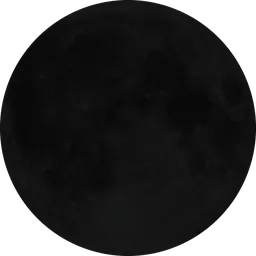 New Moon 0% lit
- 02
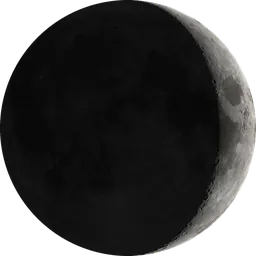 Waxing Crescent 1–49% lit
- 03
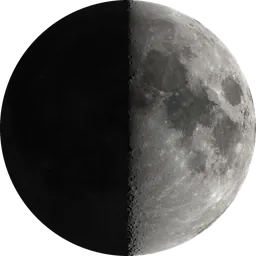 First Quarter 50% lit
- 04
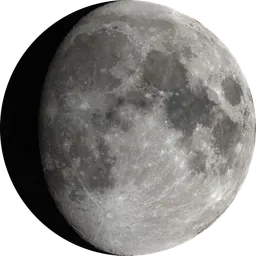 Waxing Gibbous 51–99% lit
- 05
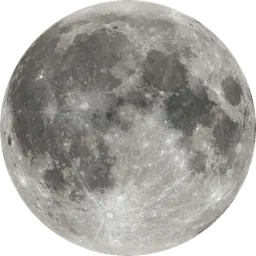 Full Moon 100% lit
- 06
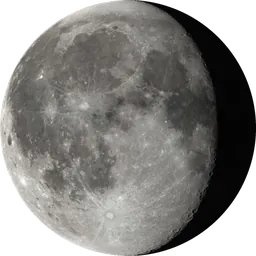 Waning Gibbous 99–51% lit
- 07
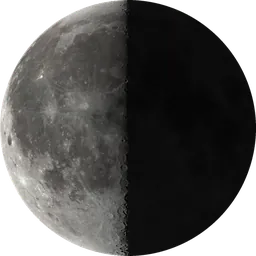 Last Quarter 50% lit
- 08
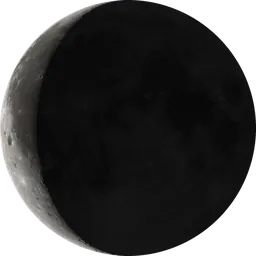 Waning Crescent 49–1% lit
Each phase follows from the changing angle between the Sun, Earth and Moon. The guide to the phases of the moon covers each one in turn, in the order they appear.
What else can you look up on MoonPhaseToday?
The panel answers the question for right now; three other tools answer it for other moments:
- The lookup for the moon phase on any date covers every day from 1900 to 2100, calculated at 12:00 UTC.
- The moon phase on your birthday tool takes your birth date, and optionally your birth time and time zone, and gives a result you can share.
- Free feeds let you add moon phases to your calendar in Google Calendar, Apple Calendar or Outlook, shown in your own time zone.