
The Moon looks upside down in the Southern Hemisphere because observers there face north to see it, while observers in the Northern Hemisphere face south, so each sees the image rotated 180° relative to the other. The Moon itself does not change: everyone on Earth sees the same near side.
Key facts
- Everyone on Earth sees the same near side of the Moon; only its orientation changes.
- From the Southern Hemisphere, the Moon is rotated about 180° compared with the view from Europe or North America.
- Near the equator, the Moon appears turned about 90°, and evening crescents often look like a smile or a boat.
- The Moon's tilt also changes during the night, between moonrise and moonset.
Why does the view flip between hemispheres?
The view flips because the direction you call “up” depends on where you stand on a round Earth, and observers on opposite sides of the equator look at the Moon from opposite directions.
From Europe, North America or northern Asia, the Moon crosses the southern part of the sky, so people face south to see it. From Australia, New Zealand, South Africa or Argentina, the Moon crosses the northern part of the sky, so people face north. Two observers on either side of the equator face each other, and each one’s “up” points the opposite way.
Think of two people sitting across a table, looking at the same photo lying flat between them. Each sees the photo upside down compared with the other. The Moon works the same way, with the equator as the table. NASA’s Scientific Visualization Studio even publishes a “South Up” edition of its yearly Moon phase and libration animation.
The features themselves never change, because the Moon is tidally locked and keeps one face toward Earth. That and other moon facts explain why the near side looks the same to every observer.
How does the Moon look from the north, the tropics and the south?
The drawings below show the Moon at its highest point in each city on the same night, updated with each daily build, as seen from London (51.5° N), Singapore (1.3° N) and Sydney (33.9° S).
Northern sky · 51.5° N
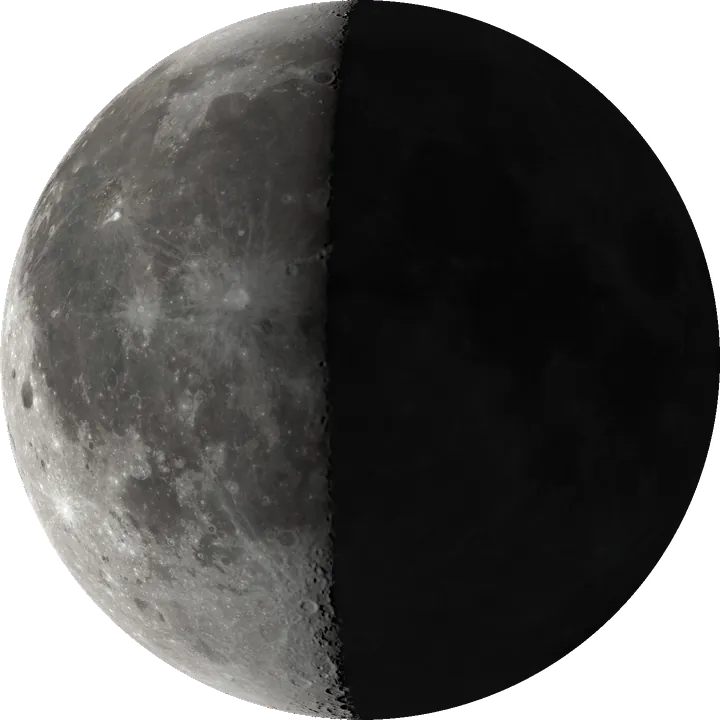
London
Near the equator · 1.4° N
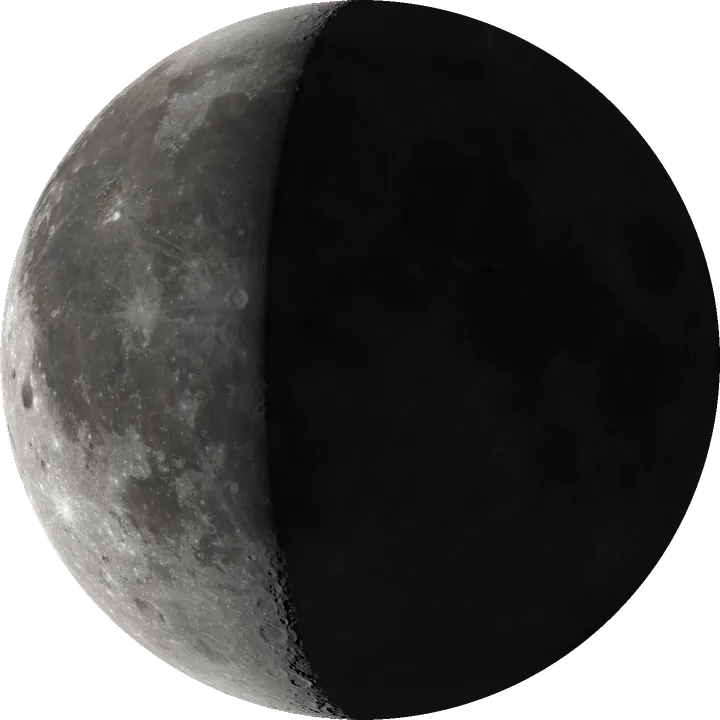
Singapore
Southern sky · 33.9° S
Sydney
From London, the Moon appears in its familiar northern orientation. From Sydney, the same Moon is turned roughly 180°, so the lit side and the dark patches sit on the opposite sides. From Singapore, close to the equator, it is turned about halfway between the two, roughly 90°.
The exact angle also depends on the time of night, so the drawing is a snapshot. For the times when the Moon is up in Sydney, see the daily moonrise in Sydney page.
Which way does a crescent face in each hemisphere?
As seen from the Northern Hemisphere, a waxing crescent is lit on the right; from the Southern Hemisphere, the same waxing crescent is lit on the left.
In both hemispheres, the lit side of a waxing crescent faces the Sun. After sunset, that means its bright edge points down toward the western horizon, where the Sun has just set. Northern observers facing south have west on their right; southern observers facing north have west on their left.
Why does the crescent look like a smile near the equator?
Near the equator, the Moon’s path rises almost straight up from the horizon, so an evening crescent often sits with the set Sun nearly below it and its lit edge facing down, like a smile or a boat.
At mid-latitudes, the Moon’s path meets the horizon at a slant. The Sun below the horizon then lies down and to one side of the Moon, so the crescent tilts left or right. In the tropics the path is steeper, so the lit edge points more nearly straight down.
The exact tilt changes with the season, because the angle between the Moon’s path and the horizon varies through the year. Observers in places such as Singapore, Nairobi or Quito often see crescents lying almost flat, with both horns pointing up.
Does the Moon’s orientation change during the night?
Yes, the Moon slowly rotates relative to the horizon as it crosses the sky, because the direction of “up” in the sky changes between moonrise and moonset.
Astronomers call this angle the parallactic angle. For a Moon near the celestial equator, the tilt at moonrise and moonset is roughly 90° minus your latitude, one way when rising and the other way when setting. The Moon looks most upright when it is highest in the sky.
| Place | Latitude | Tilt at moonrise and moonset (approx.) |
|---|---|---|
| London | 51.5° N | about 38° each way |
| Singapore | 1.3° N | close to 90° each way |
| Sydney | 33.9° S | about 56° each way |
Near the equator, the Moon rises on one side and sets on the other, so its image turns through nearly 180° in one night. Our moonrise and moonset times page shows when the Moon is low and the tilt is greatest.
How do you tell waxing from waning in the Southern Hemisphere?
In the Southern Hemisphere, a waxing Moon is lit on the left and a waning Moon is lit on the right, the reverse of the northern rule.
Northern observers often use the letters D, O and C: a waxing Moon lit on the right looks like a D, and a waning Moon lit on the left looks like a C. In the Southern Hemisphere the order runs C, O, D. Our guide to waxing vs waning covers more ways to tell the two apart.
One rule works everywhere. A Moon already in the sky at sunset is waxing, and a Moon still in the sky at sunrise is waning. The order of the eight phases of the moon is the same in both hemispheres; only the side that is lit looks reversed.
What happens to the man in the moon and the moon rabbit?
The man in the moon and the moon rabbit are shapes that people see in the Moon’s dark patches, and from the Southern Hemisphere both appear upside down compared with the northern view.
Seeing familiar shapes in random patterns is called pareidolia. The Moon’s pattern comes from two kinds of rock: dark basalt in the maria and bright anorthosite in the highlands.
- Man in the moon: many people in Europe and North America see a face in the dark maria.
- Moon rabbit: according to JAXA, people in Japan and other Asian countries have seen a rabbit in the same pattern for more than 1,000 years. In China, the jade rabbit makes the elixir of immortality; in Japan, it pounds rice cakes.
China’s lunar rovers Yutu and Yutu-2 take their name from the jade rabbit, since “Yutu” means jade rabbit in Chinese. From Sydney or Cape Town, the face and the rabbit turn over along with the rest of the Moon, and their angle shifts again through the night.
How can you see the Moon as it looks where you are?
The easiest way is to check the Moon drawn for your own location, oriented for your hemisphere and latitude.
Our homepage draws the Moon as seen from where you are, so the lit side and the tilt match your sky. Check the moon phase today to see the current phase, illumination and orientation before you step outside.