
The phases of the Moon are the eight stages of the Moon’s 29.5-day cycle of light, in order: new moon, waxing crescent, first quarter, waxing gibbous, full moon, waning gibbous, last quarter and waning crescent. One complete cycle, from new moon to new moon, averages 29.53 days.
Key facts
- The order is new moon, waxing crescent, first quarter, waxing gibbous, full moon, waning gibbous, last quarter, waning crescent.
- New moon, first quarter, full moon and last quarter are exact instants; the four phases between them last about 7.4 days each.
- One complete cycle, from new moon to new moon, averages 29.53 days.
- As seen from the Northern Hemisphere, a waxing moon is lit on the right and a waning moon on the left; the Southern Hemisphere sees the reverse.
- The phases come from the changing angle between the Sun, Earth and Moon, not from Earth's shadow.
What are the 8 phases of the Moon in order?
In order, the 8 phases run from the new moon through the waxing phases to the full moon, then through the waning phases back to the next new moon.
- 01
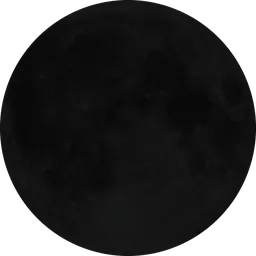 New Moon 0% lit
- 02
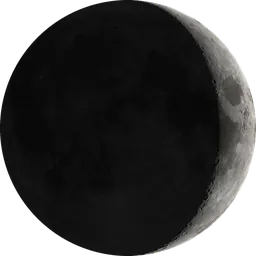 Waxing Crescent 1–49% lit
- 03
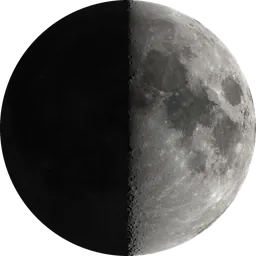 First Quarter 50% lit
- 04
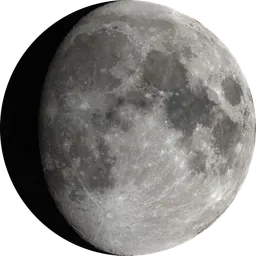 Waxing Gibbous 51–99% lit
- 05
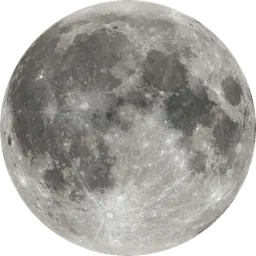 Full Moon 100% lit
- 06
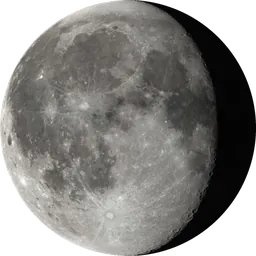 Waning Gibbous 99–51% lit
- 07
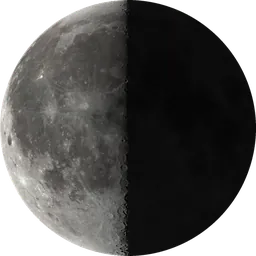 Last Quarter 50% lit
- 08
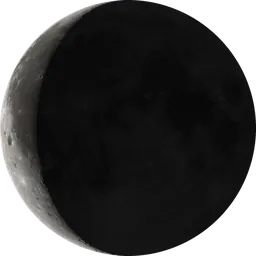 Waning Crescent 49–1% lit
The first four phases are waxing, which means the lit part grows from night to night. The last four are waning, which means the lit part shrinks. The four primary phases are exact moments, and the four phases between them last about 7.4 days each. Each phase below is described as seen from the Northern Hemisphere.
- New moon (about 0% lit). The Moon sits between Earth and the Sun, so its sunlit side faces away from us and the Moon is invisible in the Sun’s glare. The page for the next new moon gives the exact date and time the next cycle starts.
- Waxing crescent (1–49% lit). A thin curve of light appears on the right side of the Moon, low in the western sky after sunset. The waxing crescent grows thicker each evening for about a week.
- First quarter (50% lit). The right half of the Moon is lit, and the Moon stands 90° east of the Sun. The first quarter moon is a single instant, about 7.4 days after new moon.
- Waxing gibbous (51–99% lit). More than half the disc is lit, and a shrinking dark sliver remains on the left. The waxing gibbous phase lights up the evening sky in the week before full moon.
- Full moon (about 100% lit). The Moon sits opposite the Sun, so the whole near side is lit and the Moon is up all night. Dates, times and traditional names for the next full moon are listed on the full moon page.
- Waning gibbous (99–51% lit). The dark edge now appears on the right and grows each night. A waning gibbous rises after sunset and is still in the sky after sunrise.
- Last quarter (50% lit). The left half of the Moon is lit, and the Moon stands 90° west of the Sun. The last quarter moon, also called the third quarter, rises around midnight.
- Waning crescent (49–1% lit). A thin curve of light on the left side rises before dawn in the eastern sky. The waning crescent fades into the next new moon after about a week.
When does each moon phase rise, set and appear in the sky?
Each moon phase rises and sets at a typical time relative to the Sun, because the Moon moves about 12° farther east of the Sun every day and rises about 50 minutes later.
| Phase | Illuminated | Rises | Sets | Best seen |
|---|---|---|---|---|
| New Moon | 0–1% | about sunrise | about sunset | Not visible (lost in the Sun’s glare) |
| Waxing Crescent | 1–49% | mid-morning | mid-evening | Western sky after sunset |
| First Quarter | 50% | about noon | about midnight | Afternoon and evening; due south (north in the Southern Hemisphere) at sunset |
| Waxing Gibbous | 51–99% | mid-afternoon | before dawn | Evening and most of the night |
| Full Moon | about 100% | about sunset | about sunrise | All night, highest around midnight |
| Waning Gibbous | 99–51% | mid-evening | mid-morning | Late night and morning |
| Last Quarter | 50% | about midnight | about noon | After midnight and in the morning sky |
| Waning Crescent | 49–1% | before dawn | mid-afternoon | Eastern sky before sunrise |
Times are approximate local times for mid-latitudes; they shift with season and latitude.
The pattern steps forward by roughly 3 hours per phase. A new moon rises and sets with the Sun. A first quarter moon rises around noon and sets around midnight. A full moon rises at sunset and sets at sunrise, and a last quarter moon rises around midnight and sets around noon.
Approximate clock times like these assume sunrise near 6 a.m. and sunset near 6 p.m. Daylight saving time adds 1 hour, and the seasons shift the times further, especially at high latitudes. The timing explains when each phase is easy to see:
- Evening sky: waxing crescent, first quarter and waxing gibbous, which are already up at sunset.
- All night: the full moon, from sunset to sunrise.
- Late night and morning: waning gibbous, last quarter and waning crescent, which rise after sunset and stay up into daylight.
- Daytime: the waxing phases in the afternoon and the waning phases in the morning.
Why does the Moon have phases?
The Moon has phases because the Sun always lights one half of the Moon, and the share of that lit half that faces Earth changes as the Moon orbits Earth.
The Moon makes no light of its own; it reflects sunlight. At new moon the lit half faces away from Earth, and at full moon it faces Earth squarely. Between those points, observers on Earth see part of the Moon’s day side and part of its night side. The boundary between the two is called the terminator.
Earth’s shadow does not cause the phases. Earth’s shadow points directly away from the Sun, so it can only reach the Moon at full moon, and when it does, the result is a lunar eclipse. The full geometry, with the angle behind each phase, is explained on the page about why the moon has phases.
How long does each moon phase last?
The four primary phases last only an instant, and each of the four intermediate phases lasts about 7.4 days on average, ranging from roughly 6.6 to 8.2 days.
New moon, first quarter, full moon and last quarter are defined by exact angles between the Moon and the Sun along the ecliptic: 0°, 90°, 180° and 270°. A calendar names a day after a primary phase when that instant falls inside the day. This site also uses the primary name for any moment within 12 hours of the instant.
| Phase | Type | How long it lasts |
|---|---|---|
| New moon | Instant (0°) | A moment; names one calendar day |
| Waxing crescent | Interval | About 7.4 days |
| First quarter | Instant (90°) | A moment; names one calendar day |
| Waxing gibbous | Interval | About 7.4 days |
| Full moon | Instant (180°) | A moment; names one calendar day |
| Waning gibbous | Interval | About 7.4 days |
| Last quarter | Instant (270°) | A moment; names one calendar day |
| Waning crescent | Interval | About 7.4 days |
The intermediate phases vary in length because the Moon’s orbit is an ellipse. The Moon moves faster near perigee, its closest point to Earth, and slower near apogee, its farthest point. A phase that falls while the Moon is near perigee is shorter than average.
A primary phase can look as if it lasts longer than an instant. The Moon is more than 98% lit one day before and one day after the full moon, so it looks full to the eye on 2 or 3 nights in a row. Around the quarters the change is faster: the lit fraction moves by about 10 percentage points per day, so a half moon looks clearly different one night later.
How does the Moon’s age relate to its phase?
The Moon’s age is the number of days since the last new moon, and each phase falls at a typical age: first quarter near 7.4 days, full moon near 14.8 days and last quarter near 22.1 days.
| Moon’s age (days since new moon) | Phase |
|---|---|
| 0 | New moon |
| 1–7 | Waxing crescent |
| About 7.4 | First quarter |
| 8–14 | Waxing gibbous |
| About 14.8 | Full moon |
| 15–21 | Waning gibbous |
| About 22.1 | Last quarter |
| 23–29 | Waning crescent |
These ages are averages. Depending on where the Moon is in its elliptical orbit, the full moon arrives between about 13.9 and 15.6 days after the new moon.
How can you tell if the Moon is waxing or waning?
As seen from the Northern Hemisphere, a waxing moon is lit on the right and a waning moon is lit on the left; in the Southern Hemisphere the sides are reversed.
A time-of-day rule works in both hemispheres. A Moon that is already in the sky at sunset is waxing. A Moon that is still in the sky at sunrise is waning. The full moon is the only phase that is up at both times. Memory aids, the rule for observers near the equator and a side-by-side table are in the guide to waxing vs waning.
Do moon phases look different in the Southern Hemisphere?
The phase is the same everywhere on Earth on the same night, but observers in the Southern Hemisphere see the Moon rotated by about 180°, so the lit side appears on the opposite side.
A waxing crescent that is lit on the right in London or New York is lit on the left in Sydney or Cape Town. Craters and dark lunar seas also appear upside down. Near the equator, the terminator often looks horizontal in the evening and morning, so a crescent can lie flat like a bowl, with its horns pointing up. The geometry behind this flip is set out in the article on why the moon looks upside down in the southern hemisphere.
Calendar dates can also differ by location. A primary phase is one instant worldwide, so a full moon at 02:00 UTC still falls on the previous evening in New York.
How long is a full lunar cycle?
A full lunar cycle, called a synodic month, averages 29.530589 days, or 29 days 12 hours 44 minutes, from one new moon to the next.
Individual cycles range from about 29.27 to 29.83 days, because both the Moon’s orbit and Earth’s orbit are elliptical. The cycle is about 2.2 days longer than the Moon’s 27.32-day orbit relative to the stars, called the sidereal month. The extra time is needed because Earth moves along its own orbit around the Sun during the month.
A calendar year holds about 12.37 lunar cycles, which is why some years contain 13 full moons. The synodic, sidereal, anomalistic and draconic months are compared on the lunar cycle page.
How do you find the Moon’s phase today or on any date?
The Moon’s current phase, illumination and age are shown live below, and every date from 1900 to 2100 has its own phase page.
- The moon phase today page shows the current phase, the percentage lit and the next moonrise.
- The moon phase calendar draws the Moon’s shape for every day of a month, with the four primary phases marked.
- The moon phase on any date tool looks up a birthday, an anniversary or a historic date.
The next full moon falls on , and the next new moon falls on .
Which moon phase is best for viewing the Moon or the stars?
The first and last quarter phases are best for viewing lunar craters, and the days around new moon are best for viewing faint stars and galaxies.
At quarter phase, sunlight strikes the middle of the disc from the side. Crater walls and mountains near the terminator cast long shadows, so binoculars and small telescopes show strong relief. At full moon, sunlight falls straight down, shadows vanish and the surface looks flat. The full moon also brightens the whole night sky and hides faint stars, while a new moon leaves the sky dark from dusk to dawn.
Where do the moon phase names come from?
The moon phase names describe either the shape of the lit part, such as crescent and gibbous, or the Moon’s progress through its cycle, such as quarter, waxing and waning.
- Crescent comes from Latin crescere, “to grow.” Latin speakers called the waxing moon luna crescens, and the word later came to mean the shape rather than the stage.
- Gibbous comes from Latin gibbus, “a hump.” English has applied it to the bulging Moon between half and full since the early 15th century.
- Quarter describes progress, not shape. At first quarter the Moon has completed one quarter of its cycle. We see half of the Moon’s sunlit half, which is one quarter of the Moon’s whole surface.
- Half moon is the everyday name for both the first quarter and the last quarter.
- Third quarter is another name for the last quarter, used by NASA among others.
- Waxing comes from Old English weaxan, “to grow,” and waning from Old English wanian, “to diminish.” The pair has described the Moon since early Middle English.
- Old moon is a traditional name for the last thin waning crescent before new moon.
The word month has the same root. Old English monað is related to the word for moon, and a month was originally the interval from one new moon to the next.