
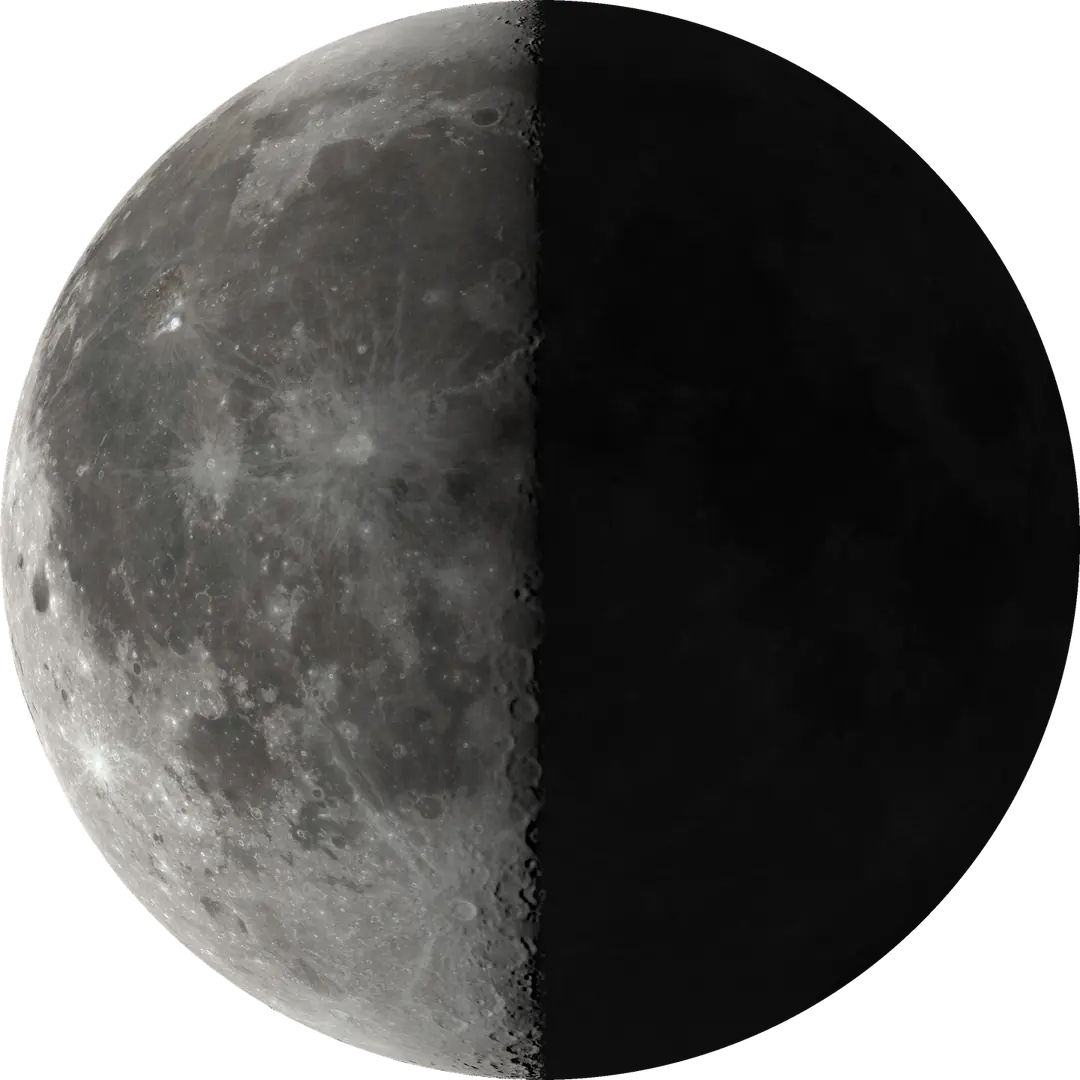
A last quarter moon is the primary Moon phase when the Moon is three quarters of the way through its cycle and 50% of its visible face is lit. It comes about 7.4 days after the full moon, rises around midnight and sets around noon.
Key facts
- An exact instant, about 7.4 days after full moon, when the Moon is 90° west of the Sun.
- Half the visible disc is lit: the left half as seen from the Northern Hemisphere, the right half as seen from the Southern Hemisphere.
- Also called the third quarter moon; both names mean the same instant.
- Rises around midnight, is highest around dawn and sets around noon.
What is a last quarter moon?
The last quarter, also called the third quarter, is one of the four primary phases of the Moon: the instant when the Moon’s ecliptic longitude is 270° east of the Sun’s, which is the same as 90° west.
At that instant, the Sun, Earth and Moon form a right angle, as they did at first quarter, but with the Moon on the other side of Earth. The last quarter falls between the waning gibbous and the waning crescent, in the shrinking half of the cycle. It is a moment, not a period. A calendar names the day that contains it, and this site also calls the Moon “last quarter” within 12 hours of that moment. The complete order of the phases of the moon shows the last quarter as the seventh stage.
Why is it called the last quarter or third quarter?
A last quarter moon is named for the Moon’s progress: three quarters of the cycle are complete, and the last quarter of the cycle is about to begin.
“Third quarter” counts the quarter marks in order: first quarter, full moon, third quarter. “Last quarter” names the final stretch of the cycle that starts at this instant. Both names refer to the same moment, and NASA uses “third quarter” in its own phase list. Like the first quarter, the phase shows half of the Moon’s sunlit half, which is one quarter of the Moon’s whole surface, and it is often called a half moon.
What does a last quarter moon look like?
As seen from the Northern Hemisphere, a last quarter moon is lit on the left half, with a nearly straight terminator down the middle.
From the Southern Hemisphere, the right half is lit, because observers there see the Moon rotated by about 180°. In both hemispheres the lit side faces the Sun. Soon after the Moon rises near midnight, the lit half points downward, toward the Sun below the horizon. The straight terminator on a last quarter moon shows where the Sun is setting on the lunar surface.
When does a last quarter moon rise and set?
A last quarter moon rises around midnight, is highest in the sky around dawn and sets around noon, local time.
| Event | Approximate local time |
|---|---|
| Moonrise | Around midnight, about 6 hours after sunset |
| Highest in the sky | Around sunrise |
| Moonset | Around noon, about 6 hours after sunrise |
These times assume sunrise near 6 a.m. and sunset near 6 p.m., and they shift with daylight saving time, the season and your latitude. The last quarter is a morning moon. After sunrise it stays visible in the southern and western sky, as seen from the Northern Hemisphere, until it sets around midday. From the Southern Hemisphere it moves through the northern and western sky instead. That long morning stretch is a clear case of why you can see the moon during the day.
A last quarter moon also sits roughly along Earth’s path around the Sun. When you look at it before dawn, you are looking forward along the direction Earth is moving in its orbit.
How long does a last quarter moon last?
A last quarter moon lasts only an instant; the waning gibbous before it and the waning crescent after it each last about 7.4 days.
Near last quarter the lit fraction drops by about 10 percentage points per day. The Moon is about 60% lit one day before the instant and about 40% lit one day after. The waning crescent that follows shrinks toward the new moon and rises later each night, closer to dawn.
When is the next last quarter moon?
The next last quarter moon is on , and the one after that is on .
Both times are in UTC, so the local date can differ by one day. Last quarters repeat every 29.53 days on average. The moon phase calendar shows the last quarter alongside the new moon, first quarter and full moon for every month.
What can you see at last quarter?
A last quarter moon puts the terminator across the middle of the disc again, so crater walls and mountain ranges cast long shadows, lit from the opposite side to the first quarter.
Craters that were catching the morning Sun at the first quarter moon now catch the evening Sun, with their shadows pointing the other way. Binoculars on a steady support show the effect well. The drawback is the timing: the last quarter is highest at dawn, so observing means getting up before sunrise.
The late rise also matters for the night sky. With moonrise near midnight, the evening hours are dark, which is useful for stargazers who want faint objects before the Moon comes up. The guide to the best moon phase for stargazing shows how those dark evening hours lengthen in the days after last quarter.
How does the last quarter affect tides?
The last quarter coincides with neap tides, the moderate tides of the month, because the Sun and the Moon pull on Earth’s oceans at right angles.
At new moon and full moon the Sun and the Moon line up, and their tides add together into spring tides with a large range. About a week after full moon, at the last quarter, the solar tide partly cancels the lunar tide. High tides are lower and low tides are higher than at spring tide, and the same pattern happens at the first quarter.