
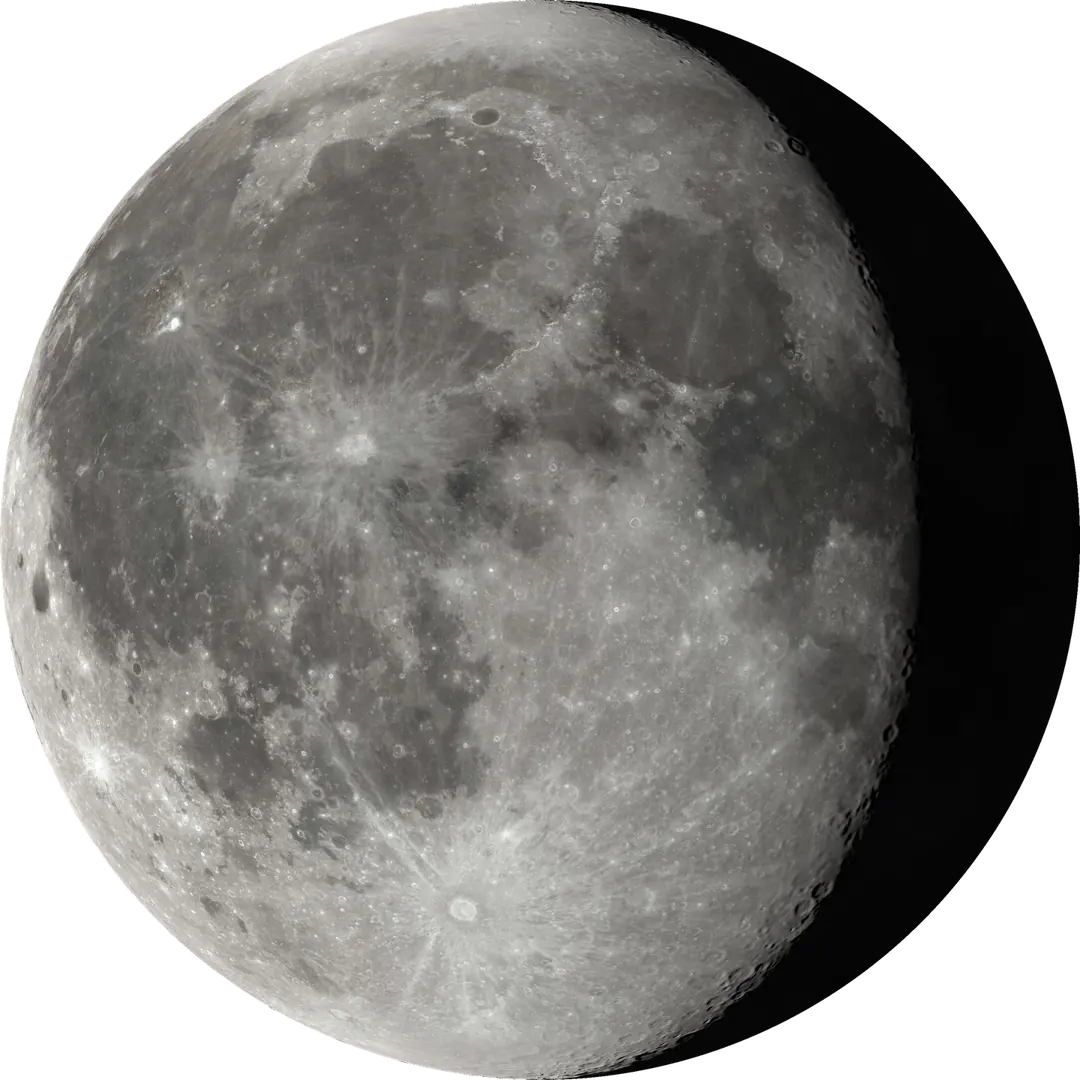
A waning gibbous moon is the phase between the full moon and the last quarter, when 99–51% of the Moon’s visible face is lit and the lit part shrinks each night. It lasts about 7.4 days, rising after sunset and staying in the sky after sunrise.
Key facts
- Lasts about 7.4 days on average, from full moon to last quarter.
- Lit on the left as seen from the Northern Hemisphere, on the right as seen from the Southern Hemisphere.
- Rises between sunset and midnight and sets in the morning after sunrise.
- The early evening before moonrise stays dark, which helps stargazers.
What is a waning gibbous moon?
The waning gibbous is the sixth of the eight phases of the Moon and the first after the full moon, a late-night and morning moon that is more than half lit but shrinking.
“Waning” means the lit part is getting smaller, and “gibbous” means it still bulges past half the disc. The phase starts just after the full moon, when the Moon is 180° from the Sun. The next full moon page lists the date and name of the full moon that begins the next waning gibbous. The phase ends at the last quarter, when the Moon is 90° west of the Sun and half lit. The full order of the phases of the moon places the waning gibbous in the third quarter of the cycle.
What does a waning gibbous moon look like?
As seen from the Northern Hemisphere, a waning gibbous moon is lit on the left and most of the right, with a dark edge on the right that grows each night.
From the Southern Hemisphere, the same Moon is lit on the right with the dark edge on the left, because observers there see the Moon rotated by about 180°. The shape is a mirror image of the waxing gibbous that came before the full moon. A rule of thumb for telling the two apart without a calendar is in waxing vs waning.
When a waning gibbous has just risen, it can glow orange or red near the horizon. Its light passes through more of Earth’s atmosphere there, which scatters away blue light, and the Moon can look like a misshapen full moon.
When does a waning gibbous moon rise and set?
A waning gibbous moon rises at night, between sunset and about midnight, and sets in the morning, after sunrise.
| Moon’s age | Lit (approx.) | Rises (approx.) | Sets (approx.) |
|---|---|---|---|
| 16 days | 98% | 7 p.m. | 7 a.m. |
| 18 days | 90% | 8:30 p.m. | 8:30 a.m. |
| 20 days | 70% | 10 p.m. | 10 a.m. |
The times assume sunrise near 6 a.m. and sunset near 6 p.m. They move about 50 minutes later each day and shift with daylight saving time, the season and your latitude. Exact times for your city are on the moonrise and moonset times page.
Where is a waning gibbous in the sky?
A waning gibbous rises in the east and climbs through the night. It reaches its highest point about 6 hours after moonrise, between roughly 1 a.m. and 5 a.m., depending on how far the phase has progressed. At that moment it stands in the southern sky as seen from the Northern Hemisphere, and in the northern sky as seen from the Southern Hemisphere. By sunrise it has moved into the western half of the sky.
The waning gibbous is a common sight in the morning. After sunrise it hangs in the western sky, pale against the blue, which is why you can see the moon during the day on many mornings in the week after full moon.
How long does the waning gibbous phase last?
The waning gibbous phase lasts about 7.4 days on average, from the instant of full moon to the instant of last quarter.
The length ranges from roughly 6.6 to 8.2 days, because the Moon moves faster near perigee and slower near apogee. On a calendar, the full moon day and the last quarter day carry those names, so a waning gibbous usually fills about 6 calendar days in between.
When is the next waning gibbous?
The next waning gibbous begins just after the next full moon, which falls on .
It then shrinks for about 7.4 days, until the last quarter that follows. When a waning gibbous is already in the sky, it ends at the next last quarter, on . The last quarter moon is the next step in the cycle, when exactly half the disc is lit.
What can you see on a waning gibbous moon?
A waning gibbous moon shows sunset moving across the Moon, with long shadows on the side opposite to where they fell during the waxing phases.
The terminator on a waning moon marks where the Sun is setting on the lunar surface. The same craters and mountains that stood out before full moon return to the terminator, now lit from the other side. Craters on the right side of the disc, as seen from the Northern Hemisphere, are the first to fall into lunar night.
For observers, the late rise of the waning gibbous is useful. The first hours after dusk stay dark until the Moon comes up, which gives a window for faint stars and galaxies. The guide to the best moon phase for stargazing explains how that dark window grows as the Moon wanes.
How is a waning gibbous different from a full moon?
A waning gibbous differs from a full moon in three ways: a dark edge appears on one side, the Moon rises later than sunset, and the Moon is no longer opposite the Sun.
In the first day or two after full moon, the waning gibbous is still more than 95% lit and looks full at a glance. A closer look shows a slightly flattened edge on the right, as seen from the Northern Hemisphere. Moonrise comes about 50 minutes after sunset on the first evening and later on each one after. Because the Moon has moved off the line opposite the Sun, crater shadows reappear along the terminator, and the surface looks less flat than at full moon.