
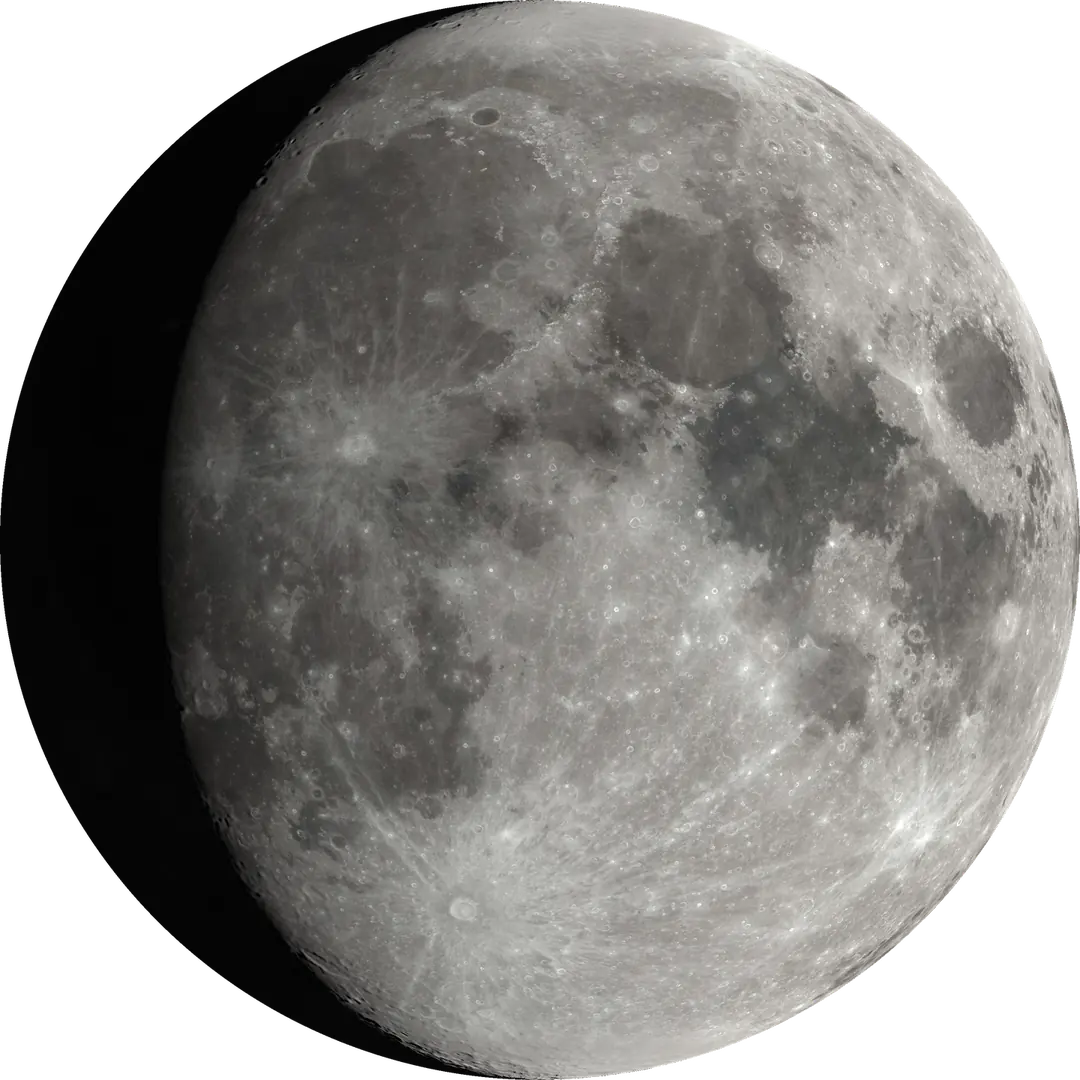
A waxing gibbous moon is the phase between the first quarter and the full moon, when 51–99% of the Moon’s visible face is lit and the lit part grows each night. The phase lasts about 7.4 days and ends when the Moon is full.
Key facts
- Lasts about 7.4 days on average, from first quarter to full moon.
- More than half lit, with a shrinking dark edge on the left as seen from the Northern Hemisphere.
- Rises in the afternoon before sunset and sets in the early hours after midnight.
- Gibbous comes from Latin gibbus, 'a hump', for the bulging shape.
What is a waxing gibbous moon?
The waxing gibbous is the fourth of the eight phases of the Moon, a more-than-half-lit Moon that rises in the afternoon and lights up most of the evening sky.
“Waxing” means the lit part is growing, and “gibbous” means the lit part bulges past half the disc. The phase begins just after the first quarter moon, when the Moon is 90° east of the Sun. It ends at the full moon, when the Moon is 180° from the Sun. The Moon moves about 12° farther from the Sun each day, so the lit fraction rises from about 50% to nearly 100% over the week. The full order of the phases of the moon shows the gibbous phase in the second quarter of the cycle.
What does a waxing gibbous moon look like?
As seen from the Northern Hemisphere, a waxing gibbous moon is lit on the right and most of the left, with a dark edge on the left that shrinks each night.
The terminator, the line between lunar day and night, curves outward past the middle of the disc, which gives the phase its lopsided, bulging look. From the Southern Hemisphere, the same Moon is lit on the left with the dark edge on the right, because observers there see the Moon rotated by about 180°. The rule behind this difference, and quick ways to tell a growing Moon from a shrinking one, are in waxing vs waning.
When does a waxing gibbous moon rise and set?
A waxing gibbous moon rises in the afternoon, before sunset, and sets in the early hours of the morning, after midnight.
| Moon’s age | Lit (approx.) | Rises (approx.) | Sets (approx.) |
|---|---|---|---|
| 9 days | 65% | 1 p.m. | 1 a.m. |
| 11 days | 85% | 3 p.m. | 3 a.m. |
| 13 days | 95% | 5 p.m. | 5 a.m. |
The times assume sunrise near 6 a.m. and sunset near 6 p.m., and they move about 50 minutes later each day. Daylight saving time, the season and your latitude shift them further.
A waxing gibbous reaches its highest point about 6 hours after moonrise, between roughly 7 p.m. and 11 p.m. At that moment it stands in the southern sky as seen from the Northern Hemisphere, and in the northern sky as seen from the Southern Hemisphere. It then sinks toward the west and sets in the early morning.
The waxing gibbous is easy to see in daylight. In the afternoon it climbs in the east while the Sun sinks in the west, and its large lit area stands out against the blue sky. That afternoon view is a good example of why you can see the moon during the day.
How long does the waxing gibbous phase last?
The waxing gibbous phase lasts about 7.4 days on average, from the instant of first quarter to the instant of full moon.
The length ranges from roughly 6.6 to 8.2 days, because the Moon moves faster near perigee and slower near apogee. On a calendar, the first quarter day and the full moon day carry those names, so a waxing gibbous usually fills about 6 calendar days in between.
When is the next waxing gibbous?
The next waxing gibbous begins just after the next first quarter, which falls on .
It then grows for about 7.4 days, until the full moon that follows. When a waxing gibbous is already in the sky, it ends at the next full moon, on . Dates, times and traditional names for the next full moon are on the full moon page.
What can you see on a waxing gibbous moon?
A waxing gibbous moon shows sunrise moving across the left part of the disc, as seen from the Northern Hemisphere, with mountain ranges and large craters standing out along the terminator.
- The Golden Handle. About 10 to 11 days after new moon, the peaks of the Montes Jura catch the morning Sun while the floor of Sinus Iridum, a 249-km (155-mile) bay, is still in shadow. The result is a bright arc of light beyond the terminator.
- Copernicus. This 93-km (58-mile) crater shows its terraced walls and central peaks when the terminator passes near it.
- Ray systems. As full moon approaches, shadows shorten and bright rays become prominent. The rays of Copernicus stretch about 800 km (500 miles) across the surrounding plains.
Moonlight also grows stronger every night of this phase. A waxing gibbous is up for most of the evening and sets only in the early morning, so faint stars and the Milky Way are washed out. The guide to the best moon phase for stargazing shows when the dark hours return.
How is the waxing gibbous different from the waning gibbous?
The waxing gibbous and the waning gibbous show the same range of 51–99% lit, but the waxing phase grows in the evening sky while the waning phase shrinks in the morning sky.
| Waxing gibbous | Waning gibbous | |
|---|---|---|
| Lit part | Grows each night | Shrinks each night |
| Comes between | First quarter and full moon | Full moon and last quarter |
| Lit side, Northern Hemisphere | Right | Left |
| Rises | Afternoon, before sunset | Evening, after sunset |
| Best seen | Evening | Late night and morning |
The waning gibbous follows the full moon and is the waxing gibbous in reverse.
Where does the word “gibbous” come from?
The word gibbous comes from Latin gibbus, “a hump,” and has described the bulging Moon in English since the early 15th century.
English first used gibbous around 1400 to mean “bulging” or “convex.” The lunar sense fits the shape: the lit part of a gibbous moon bulges out past the straight line of a quarter moon. The same word applies to both gibbous phases, before and after full moon.