
The Moon has phases because the Sun always lights one half of the Moon, and as the Moon orbits Earth we see a changing share of that sunlit half. The cycle repeats every 29.53 days on average, from new moon to new moon.
Key facts
- The Sun always lights one half of the Moon, its day side.
- The phase depends on the angle between the Sun and the Moon as seen from Earth.
- Earth's shadow does not cause the phases; it only falls on the Moon during a lunar eclipse at full moon.
- The cycle repeats every 29.53 days on average.
Why is half of the Moon always lit?
Half of the Moon is always lit because the Moon is a sphere lit from one direction by the Sun, so one hemisphere is in daylight and the other is in night.
The Moon makes no light of its own. Its glow is sunlight reflected from its gray, dusty surface. Like Earth, the Moon has a day side and a night side, and the line between them is called the terminator. The lit half is always the half that faces the Sun, wherever the Moon is in its orbit.
A day on the Moon is long. Measured from one sunrise to the next, it lasts 29.53 Earth days, the same as the cycle of the phases of the moon. Any spot on the Moon gets about 14.8 days of sunlight followed by about 14.8 days of night. Surface temperatures swing from about +120 °C (250 °F) in sunlight to about −130 °C (−208 °F) at night.
How does the Sun-Earth-Moon angle create each phase?
Each phase is set by the angle between the Sun and the Moon as seen from Earth: the wider the angle, the more of the Moon’s sunlit half faces Earth.
The Moon moves about 12° farther east of the Sun every day, completing 360° in 29.53 days. At 0° the lit half faces away from us; at 180° it faces us fully. The lit fraction follows a simple rule: it equals (1 − cos θ) ÷ 2, where θ is the angle from the Sun.
- 01
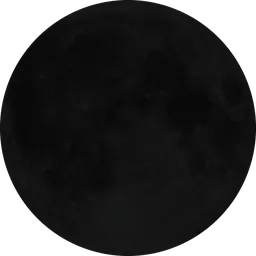 New Moon 0% lit
- 02
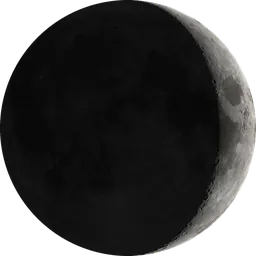 Waxing Crescent 1–49% lit
- 03
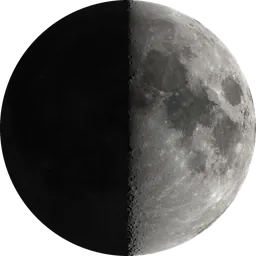 First Quarter 50% lit
- 04
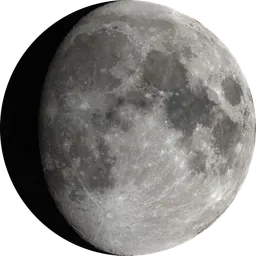 Waxing Gibbous 51–99% lit
- 05
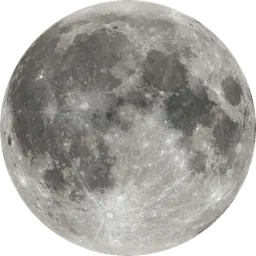 Full Moon 100% lit
- 06
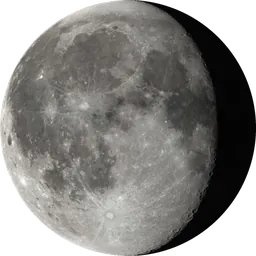 Waning Gibbous 99–51% lit
- 07
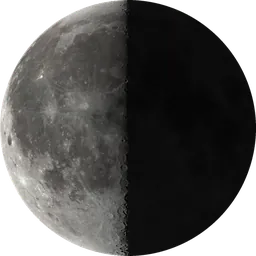 Last Quarter 50% lit
- 08
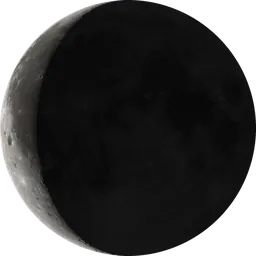 Waning Crescent 49–1% lit
| Angle from the Sun | Phase | Lit (approx.) | Where the Moon is |
|---|---|---|---|
| 0° | New moon | 0% | Between Earth and the Sun |
| 45° | Waxing crescent | 15% | East of the Sun, in the evening sky |
| 90° | First quarter | 50% | At a right angle to the Sun |
| 135° | Waxing gibbous | 85% | Rising in the afternoon |
| 180° | Full moon | 100% | Opposite the Sun |
| 225° | Waning gibbous | 85% | Rising after sunset |
| 270° | Last quarter | 50% | At a right angle on the other side |
| 315° | Waning crescent | 15% | West of the Sun, in the morning sky |
At new moon, the Moon sits between Earth and the Sun, and its lit half faces away from us, so the Moon is invisible; the next new moon page gives the date of the next one. At full moon, Earth sits between the Sun and the Moon, and the whole lit half faces us. The next full moon page lists the date, time and name of the next one.
The angle also explains where each phase appears in the sky. A thin crescent is always close to the Sun, so it is only seen in twilight. A gibbous moon is far from the Sun, so it is up for most of the night.
The Moon completes one orbit relative to the stars in 27.32 days, but needs 29.53 days to return to the same angle from the Sun. The difference comes from Earth’s own motion around the Sun, as explained on the lunar cycle page.
Try it with a lamp and a ball
The phases can be reproduced indoors. In a dark room, stand facing a lamp and hold a ball at arm’s length, slightly above your head so your head does not shadow it. Turn slowly to your left. The ball’s lit part grows from a thin crescent to a half to a full disc, then shrinks again, in the same order as the Moon’s phases seen from the Northern Hemisphere. Your head plays the part of Earth, and the lamp plays the Sun.
Why is the Moon’s phase not caused by Earth’s shadow?
The phases are not caused by Earth’s shadow, because Earth’s shadow always points directly away from the Sun and can only reach the Moon when the Moon is opposite the Sun, at full moon.
The shadow idea is a common misconception. Three observations rule it out:
- Crescents appear near the Sun. A crescent moon is seen in twilight, close to the Sun in the sky. Earth’s shadow points the other way, into the night sky opposite the Sun, so it cannot touch a crescent.
- The dark part is the Moon’s own night side. The unlit part of a crescent or quarter moon is simply the half of the Moon facing away from the Sun.
- A real shadow looks different. When Earth’s shadow does fall on the Moon, during a lunar eclipse, it moves across a full moon in a few hours and often turns it coppery red. Phases change slowly over days and never turn the Moon red.
What is the difference between a moon phase and a lunar eclipse?
A moon phase is our changing view of the Moon’s sunlit half and happens every month, while a lunar eclipse is Earth’s shadow falling on the Moon and happens only at some full moons.
The Moon’s orbit is tilted 5.14° to Earth’s orbit around the Sun. At most full moons the Moon passes above or below Earth’s shadow, so there is no eclipse. An eclipse happens only when a full moon falls close to one of the two points where the Moon’s orbit crosses Earth’s orbital plane. Those alignments come in eclipse seasons about every 173 days. A solar eclipse is the reverse case: it happens only at new moon, when the Moon’s shadow falls on Earth.
| Moon phase | Lunar eclipse | |
|---|---|---|
| Cause | Changing viewing angle of the sunlit half | Earth’s shadow falling on the Moon |
| When | Every day of every month | Only at full moon, near an eclipse season |
| Speed of change | Gradual, over days | A few hours from start to end |
| Typical look | Sharp terminator, gray dark side | Curved shadow edge, often red at totality |
The full story of eclipse timing is on the lunar eclipse page, and the differences between the two kinds of eclipse are listed in lunar vs solar eclipse.
Why do we always see the same face if the phases change?
We always see the same face because the Moon rotates exactly once per orbit, but sunlight sweeps across that face as the Moon moves around Earth.
The near side always points toward Earth, while the Sun’s direction changes through the month. At new moon the near side is in night and the far side is in full sunlight. At full moon the near side is fully lit and the far side is dark. The phases are this sweep of daylight across a face that never turns away from us. The far side is therefore not a permanently dark side; it gets the same amount of sunlight as the near side.
Does Earth have phases as seen from the Moon?
Earth shows phases to an observer on the Moon, and they are always the opposite of the Moon’s phase as seen from Earth.
When we see a new moon, an observer on the Moon would see an almost full Earth. When we see a full moon, Earth would look nearly new from the Moon. That bright, nearly full Earth is what lights the Moon’s night side during the crescent phases. The faint glow, called earthshine, is sunlight reflected from Earth to the Moon and back again, and it is easiest to see on a thin waxing crescent in the evening sky.