
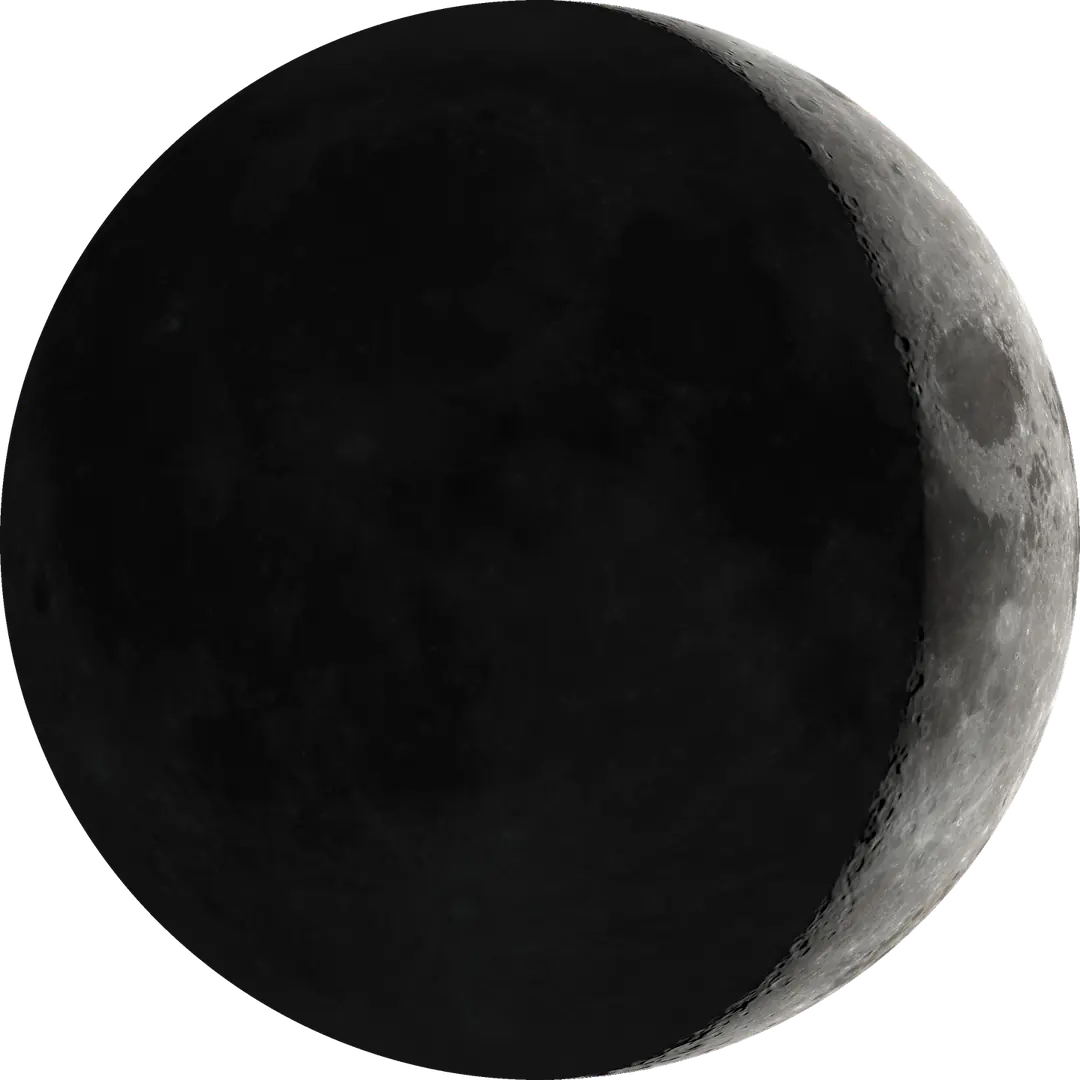
A waxing crescent is the Moon phase between the new moon and the first quarter, when 1–49% of the Moon’s visible face is lit and the lit part grows each evening. The phase lasts about 7.4 days and is best seen low in the western sky after sunset.
Key facts
- Lasts about 7.4 days on average, from new moon to first quarter.
- Lit on the right as seen from the Northern Hemisphere, on the left as seen from the Southern Hemisphere.
- Rises in the morning after the Sun and sets in the evening after the Sun.
- Best seen low in the west after sunset, often with earthshine on its dark part.
What is a waxing crescent moon?
The waxing crescent is the second of the eight phases of the Moon and the first one you can see after the Moon passes between Earth and the Sun.
“Waxing” means the lit part is growing, and “crescent” means less than half of the disc is lit. The phase starts just after the new moon, when the Moon has moved a few degrees east of the Sun. It ends at the first quarter, when the Moon is 90° from the Sun and half lit. Each day the Moon moves about 12° farther from the Sun, so the crescent grows from a thread of light to almost half a disc in about a week. The full sequence of the phases of the moon shows where the crescent sits in the 29.5-day cycle.
What does a waxing crescent look like?
As seen from the Northern Hemisphere, a waxing crescent is a thin curve of light on the right side of the Moon, with its horns pointing left, away from the Sun.
The lit edge always points toward the Sun, which sits below the western horizon after sunset. The curved inner edge is the terminator, the line between lunar day and lunar night. Early in the phase only a few percent of the disc is lit, and the crescent can be hard to find in twilight. By the end of the phase, almost half the disc is lit.
From the Southern Hemisphere, the same crescent is lit on the left, because observers there see the Moon rotated by about 180°. Near the equator, the evening crescent often lies almost flat, with its horns pointing up like a bowl.
The quickest way to tell a growing crescent from a shrinking one in either hemisphere is set out in waxing vs waning. Its mirror image, the waning crescent, appears before sunrise in the last week of the cycle.
When does a waxing crescent rise and set?
A waxing crescent rises in the morning after the Sun and sets in the evening after the Sun, so it is seen in the western sky after sunset.
The gap between sunset and moonset grows each day, because the Moon rises about 50 minutes later from one day to the next. The reason for that daily delay is explained in why the moon rises later each day.
| Days after new moon | Lit (approx.) | Rises (approx.) | Sets (approx.) |
|---|---|---|---|
| 1 | 1% | 50 minutes after sunrise | 50 minutes after sunset |
| 3 | 10% | 2.5 hours after sunrise | 2.5 hours after sunset |
| 5 | 25% | 4 hours after sunrise | 4 hours after sunset |
| 7 | 45% | 6 hours after sunrise | 6 hours after sunset |
These values are averages. The daily delay ranges from about 30 to 70 minutes at mid-latitudes, depending on the season. A crescent is above the horizon for most of the afternoon, which is why you can see the moon during the day in the days before first quarter.
The best time to look is in evening twilight, soon after sunset, before the crescent follows the Sun below the western horizon. A clear, flat view to the west helps with the thinnest crescents.
How long does the waxing crescent phase last?
The waxing crescent phase lasts about 7.4 days on average, from the instant of new moon to the instant of first quarter.
The length ranges from roughly 6.6 to 8.2 days. The Moon moves faster near perigee, its closest point to Earth, and slower near apogee, so a crescent phase that falls near perigee is shorter. On a calendar, the day of the new moon and the day of the first quarter carry those names, so a waxing crescent usually fills about 6 calendar days in between.
When is the next waxing crescent?
The next waxing crescent begins just after the next new moon, which falls on .
It then runs for about 7.4 days, until the first quarter that follows. When a waxing crescent is already in the sky, it ends at the next first quarter, on . The page for the next new moon explains why the Moon is invisible at the start of the cycle. The first quarter moon that ends the crescent phase is the next step in the cycle.
What can you see on a waxing crescent?
A waxing crescent shows earthshine on its night side and long shadows along the terminator, where the Sun is rising on the Moon.
Earthshine
Earthshine is sunlight reflected from Earth onto the Moon’s night side and back again, which makes the dark part of the crescent glow faintly. It is easiest to see a few nights before or after new moon, during the crescent phases. At those times an observer on the Moon would see a nearly full Earth in the sky. Leonardo da Vinci explained the glow in the early 16th century, when he realized that Earth and the Moon both reflect sunlight. A traditional description of the sight is “the new moon with the old moon in her arm.”
Sunrise along the terminator
Along the terminator the Sun is just rising on the Moon, so crater rims and mountains cast long shadows. Binoculars show the effect clearly, and the terminator moves about 12° of lunar longitude each day, bringing new features into view. The waxing crescent also sets in the evening and leaves most of the night dark, and the guide to the best moon phase for stargazing shows how to plan around moonlight.
What does the waxing crescent mean in calendars and language?
The waxing crescent marks the start of the month in the Islamic calendar, and its English name comes from the Latin word for “growing.”
The Islamic calendar is lunar, with 12 months of 29 or 30 days. Ramadan and other Islamic months traditionally begin with the sighting of the waxing crescent after the new moon. Because 12 lunar months add up to 354 or 355 days, these months move through the seasons over about 32.5 years.
The word crescent comes from Latin crescere, “to grow.” Latin speakers called the waxing moon luna crescens, describing its growth. The word later came to mean the curved shape itself, and English now uses it for both the waxing and the waning crescent.