
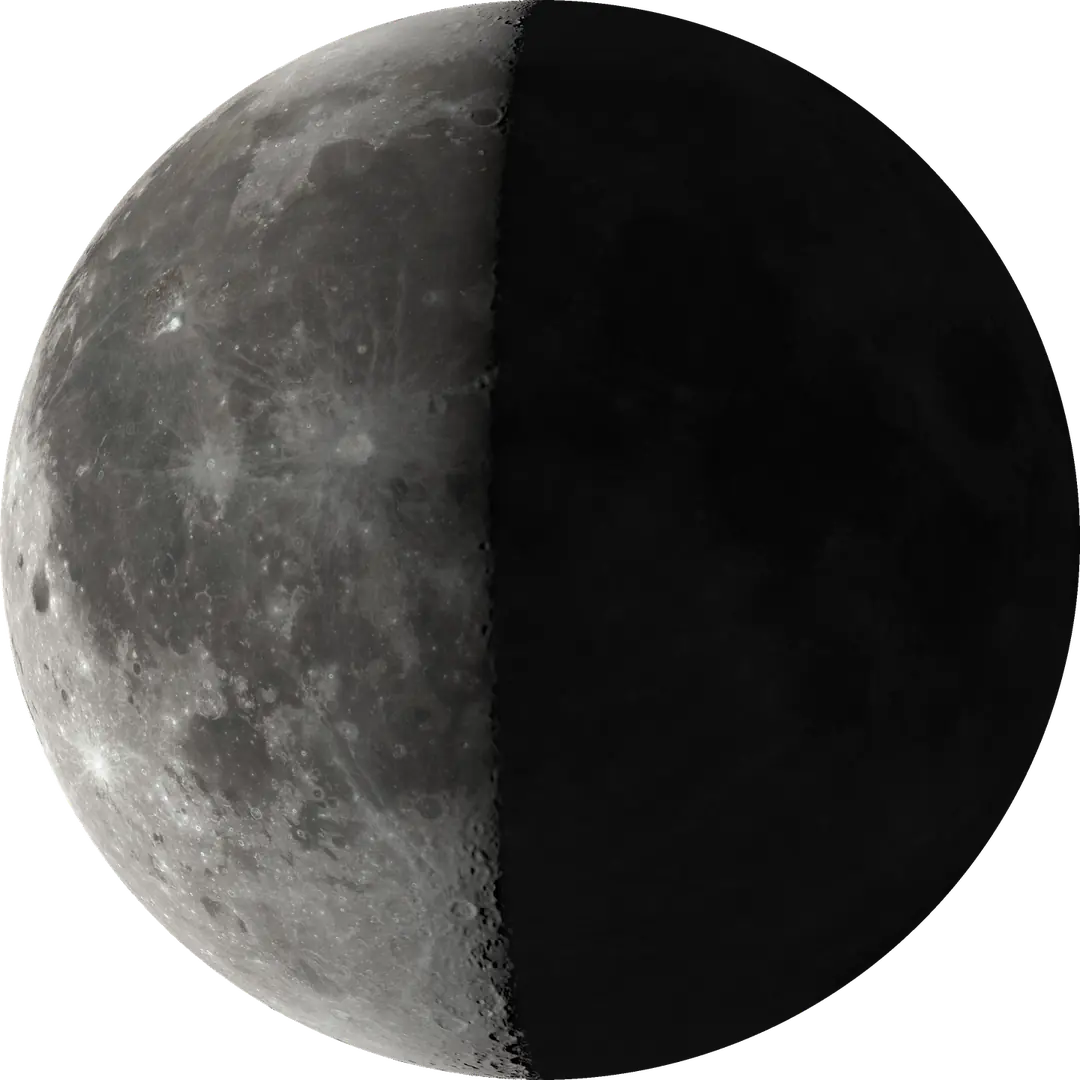
The Moon tonight is the phase, position and timing of the Moon in your evening sky, which the panel above calculates for your approximate location. Where the Moon appears depends mostly on its phase: a crescent hangs low in the west after sunset, a full moon rises in the east as the Sun sets, and a last quarter moon does not rise until around midnight.
Where should you look for the Moon tonight?
The Moon rises in the east, reaches its highest point due south from mid-northern latitudes (due north from mid-southern latitudes) and sets in the west, so its evening position depends on its phase. The panel above gives the exact direction and height through the evening, and the moon phase today page adds the illumination, age and distance.
As seen from the Northern Hemisphere, the Moon sits here in the evening (from the Southern Hemisphere, read north for south):
- Waxing crescent: low in the west after sunset, setting a few hours after the Sun.
- First quarter: high in the south around sunset, setting around midnight.
- Waxing gibbous: in the southeast at dusk and up for most of the night.
- Full moon: rising in the east around sunset and up all night.
- Waning gibbous: rising in the east during the evening, later each night.
- Last quarter: rising in the east around midnight.
- Waning crescent: rising in the east a few hours before sunrise, so it is a morning Moon.
- New moon: not visible, because it is in the same part of the sky as the Sun.
What time does the Moon rise in each phase?
Moonrise is tied to the phase: a new moon rises around sunrise, a first quarter moon around noon, a full moon around sunset and a last quarter moon around midnight. Each sets about 12 hours after it rises.
| Phase | Moonrise | Highest point | Moonset |
|---|---|---|---|
| New moon | Around sunrise | Around noon | Around sunset |
| Waxing crescent | Mid-morning | Mid-afternoon | Mid-evening |
| First quarter | Around noon | Around sunset | Around midnight |
| Waxing gibbous | Mid-afternoon | Mid-evening | Before dawn |
| Full moon | Around sunset | Around midnight | Around sunrise |
| Waning gibbous | Mid-evening | After midnight | Mid-morning |
| Last quarter | Around midnight | Around sunrise | Around noon |
| Waning crescent | Before dawn | Mid-morning | Mid-afternoon |
These are averages. The real times drift about 50 minutes later each day, and the size of that step changes with the season and your latitude. The page on moonrise and moonset times gives exact times for the next 7 days, and the article on why the moon rises later each day explains the drift.
Why is the Moon low in the sky on some nights and high on others?
The Moon stays within 5.14° of the ecliptic, the Sun’s yearly path across the sky, so it rides high where the summer Sun rides high and low where the winter Sun sits. Which part of the ecliptic the Moon occupies depends on its phase and the season.
A full moon sits opposite the Sun, so it does the reverse of the Sun. A winter full moon climbs high and stays up for a long night, while a summer full moon skims low across the southern sky (as seen from the Northern Hemisphere). The same logic puts the first quarter moon highest on spring evenings and the last quarter moon highest on autumn mornings.
A slower cycle adds to this. Over 18.6 years, the Moon’s monthly swing north and south of the celestial equator grows from 18.3° to 28.6° and back. In years near a major lunar standstill, most recently around December 2024, a full moon seen from latitude 40°N can peak anywhere from about 21° above the horizon in midsummer to about 79° in midwinter.
How can you see and photograph the Moon tonight?
The best views come along the terminator, the line between the lit and dark parts of the Moon, where shadows are longest and craters stand out. Crescent and quarter phases therefore show more relief than a full moon, which looks bright and flat.
- Binoculars: any pair shows the dark plains (maria) and the largest craters. Brace them against a wall or mount them on a tripod to stop the shake.
- Earthshine: a few days either side of new moon, the dark part of a crescent glows faintly with sunlight reflected from Earth. Look after dusk during a waxing crescent and before dawn during a waning crescent.
- Camera settings: a starting exposure for the sunlit Moon is the “Looney 11” rule: aperture f/11 and a shutter speed of 1/ISO, such as 1/100 second at ISO 100. Use a tripod and a 2-second timer.
- Phone: tap the Moon to focus, then lower the exposure until the surface shows detail instead of a white disc.
- Moonrise shots: a rising full moon looks huge beside the landscape, but a camera records it at its normal size. A long lens from far away makes the Moon large next to buildings or hills.
When is the sky dark enough for stargazing?
The sky is fully dark once the Sun is more than 18° below the horizon, the end of astronomical twilight, and the panel’s dark window is the part of that time when the Moon is also below the horizon.
Around new moon the dark window can last all night. Around full moon it may not exist at all, because the Moon is up from dusk to dawn. In between, the moon-free hours come after moonset in the waxing half of the cycle and before moonrise in the waning half.
Summer at higher latitudes can remove the window entirely. Above about 48.5° latitude, around the June solstice the Sun never sinks 18° below the horizon, so twilight lasts all night; in the Southern Hemisphere the same happens around the December solstice. The guide to the best moon phase for stargazing explains how to plan around these limits.
What if clouds hide the Moon?
The panel shows where the Moon is in the sky even when clouds hide it, because the calculation uses no weather data. A local forecast or a satellite cloud map tells you whether the sky will be clear.
Thin, high cloud often lets the Moon show through and can form a ring of light around it, a halo made by ice crystals. Thick, low cloud hides the Moon completely. If the weather wins, the moon phase calendar shows how the coming nights compare, since the Moon rises about 50 minutes later each night and its shape changes visibly from one night to the next.