
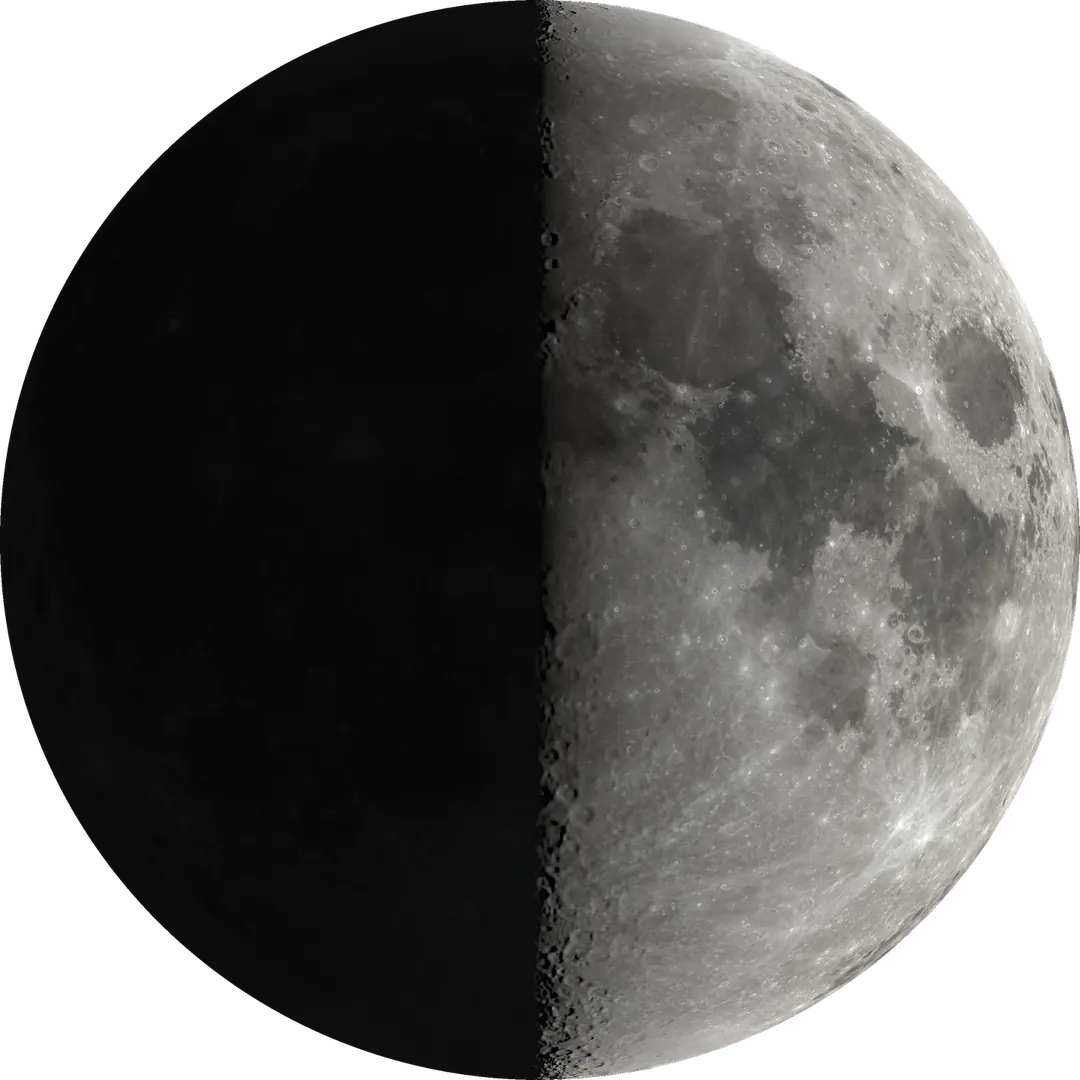
A first quarter moon is the Moon phase when the Moon has completed one quarter of its cycle and 50% of its visible face is lit. It comes about 7.4 days after the new moon, rises around noon and sets around midnight.
Key facts
- An exact instant, about 7.4 days after new moon, when the Moon is 90° east of the Sun.
- Half the visible disc is lit: the right half as seen from the Northern Hemisphere, the left half as seen from the Southern Hemisphere.
- Called a quarter because the Moon has completed one quarter of its 29.5-day cycle.
- Rises around noon, is highest around sunset and sets around midnight.
- One of the best phases for viewing craters through binoculars or a telescope.
What is a first quarter moon?
In astronomy, the first quarter is one of the four primary phases of the Moon, the instant when the Moon’s ecliptic longitude is 90° east of the Sun’s, though most people call it a half moon.
At that instant, the Sun, Earth and Moon form a right angle. The first quarter falls between the waxing crescent and the waxing gibbous, in the growing half of the cycle. Like the new moon and the full moon, it is a moment, not a period. A calendar names the day that contains that moment, and this site also calls the Moon “first quarter” within 12 hours of it. All eight stages are laid out in order on the phases of the moon page.
Why is a half moon called a first quarter?
A half-lit moon is called a first quarter because the Moon has completed the first quarter of its cycle, not because a quarter of the disc is lit.
The name describes the Moon’s progress from one new moon to the next. Two more quarter marks follow: the full moon at the halfway point and the last quarter at three quarters. The name also fits the geometry. The Sun lights half of the Moon, and at first quarter we see half of that lit half, which is one quarter of the Moon’s whole surface. “Half moon” is simply the everyday name for both the first quarter and the last quarter.
What does a first quarter moon look like?
As seen from the Northern Hemisphere, a first quarter moon is lit on the right half, with a nearly straight line dividing light from dark.
The dividing line looks straight because the terminator, the boundary between lunar day and night, is seen edge-on. From the Southern Hemisphere, the left half is lit, because observers there see the Moon rotated by about 180°. In both hemispheres the lit side faces the Sun, which is in the west during the afternoon and evening.
A first quarter moon shows half the lit area of a full moon but is far less than half as bright. At quarter phase, sunlight strikes the surface from the side, and the shadows of craters and mountains darken much of the lit half. At full moon those shadows disappear and the surface reflects sunlight strongly back toward Earth.
When does a first quarter moon rise and set?
A first quarter moon rises around noon, is highest in the sky around sunset and sets around midnight, local time.
| Event | Approximate local time |
|---|---|
| Moonrise | Around noon, about 6 hours after sunrise |
| Highest in the sky | Around sunset |
| Moonset | Around midnight, about 6 hours after sunset |
These times assume sunrise near 6 a.m. and sunset near 6 p.m. They shift with daylight saving time, the season and your latitude. Exact times for your city are on the moonrise and moonset times page.
Because the first quarter moon sets around midnight, the evening sky is bright with moonlight, and the hours after moonset are dark. Observers who want faint galaxies and nebulae can use the guide to the best moon phase for stargazing to find darker nights.
How long does a first quarter moon last?
A first quarter moon lasts only an instant; the waxing crescent before it and the waxing gibbous after it each last about 7.4 days.
Near first quarter the lit fraction grows by about 10 percentage points per day. The Moon is about 40% lit one day before the instant and about 60% lit one day after. The first quarter comes 7.4 days after new moon on average, with a range of roughly 6.6 to 8.2 days, because the Moon moves faster near perigee and slower near apogee. The waxing gibbous phase that follows grows until the full moon.
When is the next first quarter moon?
The next first quarter moon is on , and the one after that is on .
Both times are in UTC. A first quarter that falls just after midnight UTC still occurs on the previous calendar date in the Americas. First quarters repeat every 29.53 days on average. The moon phase calendar shows all four primary phases for each month.
Why is the first quarter the best phase for a telescope?
The first quarter is one of the best phases for a telescope because the terminator crosses the middle of the disc, where low sunlight throws long shadows from crater walls and mountains.
At full moon the Sun shines straight down on the near side, so the surface looks flat. Around first quarter, features near the terminator stand out in strong relief, and each night the terminator moves about 12° of lunar longitude to reveal new ones.
- Lunar X. For a few hours before first quarter, sunlight catches the rims of the craters Blanchinus, La Caille and Purbach and forms a bright X just inside the terminator.
- Lunar V. A smaller V-shaped pattern of light, the Lunar V, can be seen near the terminator around the same time.
- Rupes Recta. This long, straight fault appears as a dark line of shadow during the first quarter phase.
- Crater shadows. Craters on the terminator show their central peaks and terraced walls, with shadows that shorten from night to night.
The same features return to the terminator at the last quarter moon, lit from the opposite side, but that phase rises around midnight and is best seen before dawn.
How does the first quarter affect tides?
The first quarter coincides with neap tides, the moderate tides of the month, because the Sun and the Moon pull on Earth’s oceans at right angles.
At new moon and full moon, the Sun and the Moon line up, and their tides add together into spring tides with a large range. About a week later, at first quarter, the solar tide partly cancels the lunar tide. High tides are lower and low tides are higher than at spring tide. The same pattern returns at the last quarter.