
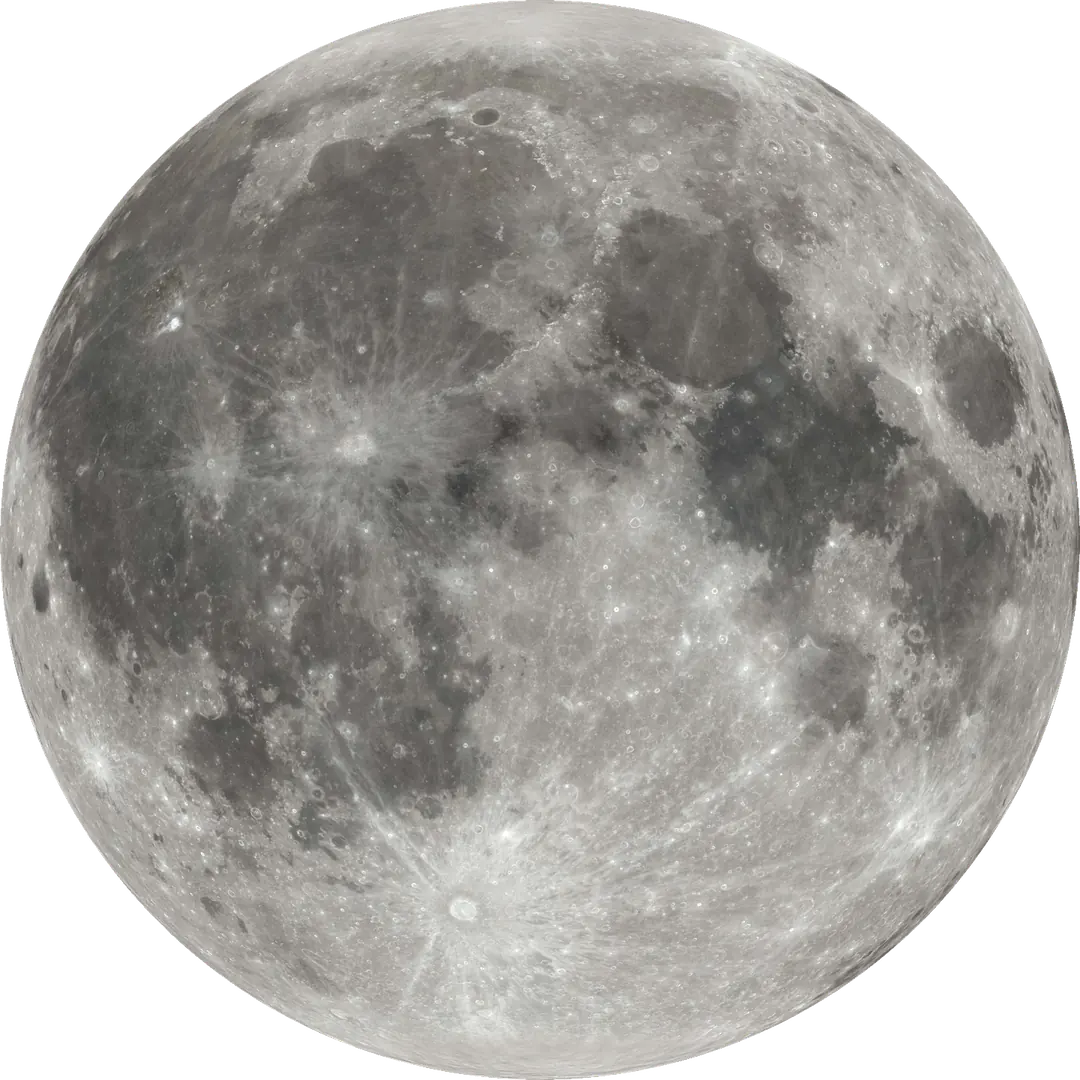
The next Strawberry Moon is full on . The Strawberry Moon is the full moon of June in the traditional North American almanac naming, named for the wild strawberries that ripen in early summer.
When is the Strawberry Moon?
The Strawberry Moon is the full moon that falls in June by Coordinated Universal Time (UTC), and the table below lists the upcoming dates with local times.
The full moon is one instant, so its local date depends on the time zone. A Strawberry Moon early on June 1 in UTC is still a May 31 full moon in New York. A late-June full moon can fall on July 1 in Sydney. This site names each full moon by its UTC month and lists New York, London and Sydney times beside the UTC time.
The June solstice falls around June 21, so the Strawberry Moon can be the last full moon of spring or the first of summer. For the very next full moon of any month, see the next full moon.
The Strawberry Moon is the sixth of the twelve full moon names used by the Farmers’ Almanac and the Old Farmer’s Almanac.
Key facts
- The Strawberry Moon is the full moon of June; this site assigns the name by the UTC date.
- The name marks the short season when June-bearing strawberries ripen, not the Moon's color.
- At New York's latitude it peaks only about 20–32° high; at London's, about 10–21°.
- Its long, low path through the atmosphere can make it look golden, amber or reddish.
Full moon time around the world
The Strawberry Moon is full at the same instant everywhere, 00:45 UTC on Saturday, June 19, 2027, which is 8:45 PM on June 18 in New York and 10:45 AM on June 19 in Sydney.
Los Angeles
17:45
Fri 18 Jun · PDT
New York
20:45
Fri 18 Jun · EDT
London
01:45
Sat 19 Jun · GMT+1
Your time
00:45
Sat 19 Jun · UTC
Delhi
06:15
Sat 19 Jun · GMT+5:30
Sydney
10:45
Sat 19 Jun · GMT+10
Why is it called the Strawberry Moon?
The Strawberry Moon is named for the short season when wild strawberries are ripe and ready to gather.
The Old Farmer’s Almanac says Algonquian tribes of the northeastern United States, as well as the Ojibwe, Dakota and Lakota peoples, used the name. It marked the ripening of “June-bearing” strawberries. The Farmers’ Almanac and EarthSky also describe it as a name for the brief strawberry harvest of June.
The name has nothing to do with the Moon’s color. Any reddish or golden tint comes from Earth’s atmosphere, not from the fruit.
Other names for the June full moon
Other names for the June full moon include the Rose Moon, Honey Moon, Berries Ripen Moon and Hatching Moon, and they describe ripening berries, blooming plants, hatching birds and early summer heat.
The Old Farmer’s Almanac lists these names with the peoples it credits:
- Berries Ripen Moon (Haida)
- Blooming Moon (Anishinaabe)
- Green Corn Moon (Cherokee)
- Hoer Moon (Western Abenaki)
- Birth Moon (Tlingit)
- Egg Laying Moon and Hatching Moon (Cree)
The Old Farmer’s Almanac also lists Honey Moon and Mead Moon as European names. It notes that June was traditionally a month of marriage, named after the Roman goddess Juno, and that the word honeymoon may be tied to this name. The Farmers’ Almanac adds Rose Moon to the European list.
Why is the Strawberry Moon so low in the sky?
The Strawberry Moon rides low because a full moon sits opposite the Sun, and the June Sun climbs to its highest point of the year near the solstice.
The June full moon therefore follows the low path that the Sun takes in midwinter. At the latitude of New York, it peaks only about 20–32° above the southern horizon. At London’s latitude it reaches about 10–21°. It rises well south of due east around sunset and sets well south of due west around sunrise.
Short summer nights keep it above the horizon for about 9–10 hours in New York and about 8 hours in London. The Strawberry Moon usually sits in Ophiuchus or Sagittarius. In about three of every ten years it passes within 10° of Antares, the red supergiant in Scorpius. The Strawberry Moon of June 15, 2011 was a total lunar eclipse, with about 100 minutes of totality.
Why can the Strawberry Moon look golden?
A low full moon often looks golden, amber or reddish because its light crosses a long path through the densest part of Earth’s atmosphere.
The Old Farmer’s Almanac explains that a Moon close to the horizon usually appears reddish because its light passes through the densest layers of the atmosphere. Those layers scatter blue light out of the beam and let warmer colors through. A winter full moon soon climbs high above that thick layer. The Strawberry Moon never climbs far, so at high northern latitudes it can keep a warmer tint through the night.
A low Moon near the horizon also looks larger because of the Moon illusion, though its measured size does not change. To catch it as it clears the horizon, check local moonrise and moonset times.
The Strawberry Moon in the Southern Hemisphere
In the Southern Hemisphere the Strawberry Moon is a midwinter full moon, and it is usually the highest full moon of the year there.
Seen from Sydney, the June full moon passes about 74–85° above the northern horizon, close to overhead. It stays up for about 15 hours on a long winter night. Observers there also see the Moon’s face rotated compared with the northern view, which is explained in why the moon looks upside down in the southern hemisphere.
The full moon before the Strawberry Moon is May’s Flower Moon. The next is July’s Buck Moon, named for the new antlers of male deer.